
To check a custom baseball cap, compare the finished cap with the approved sample and the written order requirements. Inspect the fabric and color, crown, seams, brim, decoration, fit, closure, labels, and packing. Then record any differences by style and color, agree on a correction, and confirm the result before approving the affected goods for shipment.
A cap can look well made and still be wrong for your order if its logo, sizing, or carton assortment differs from what you approved.
Use this guide when approving a sample, reviewing production output, or arranging a pre-shipment inspection. The sample shows how the cap should look and feel; the specification, artwork, measurement method, and packing instructions cover details that a single physical cap cannot establish on its own.
Custom Baseball Cap Quality Checklist at a Glance
Keep one record for each style and colorway. Mark each line as pass, discrepancy, or not applicable, and identify the reference you used. If a detail was never agreed, resolve it before calling it a defect or approving a change.
| Inspection Item | What to Check | Compare With | Record or Action |
| Fabric and color | Material, visible marks, holes, shade across panels and matching caps | Approved swatch, sample, specification | Photo and identify affected colorway |
| Crown and panels | Profile, symmetry, center seam, panel joins, eyelets and button if specified | Approved sample and construction drawing | Note view and affected panel |
| Stitching and interior | Skipped or loose stitches, puckering, sweatband and seam tape | Sample and stated construction details | Photograph seam and extent |
| Brim or visor | Centering, shape, edge, stitch rows and attachment | Sample and brim specification | Record left/right or profile difference |
| Logo and decoration | Finished size, position, color, legibility and finish | Approved artwork and decorated sample | Measure or photograph from agreed landmarks |
| Measurements and closure | Named measurement points, fit, hardware and adjustment | Size chart, measurement method, sample | Record actual values and function |
| Labels and packing | Wording, placement, assortment, count and carton marks | Approved label files and packing instructions | List SKU, carton, quantity and correction |
Start With an Approved Inspection Reference
Before approving the first sample, name the exact style, revision, fabric, colorway, artwork version, and components. Keep the approved physical sample or agreed reference photos with a dated specification.
Record the logo dimensions and position from repeatable landmarks, the points and method used to measure the cap, the closure and labels, and the packing plan. If the sample changes, update the reference; an earlier sample and a later specification should not give conflicting instructions.
A sample is useful for assessing the crown silhouette, hand feel, brim profile, and how a decorated logo looks on the assembled cap. It cannot settle an entire size range, every colorway, all carton assortments, or an unstated tolerance. Agree on those items in writing. For the names of components such as sweatband, eyelets, and visor, see parts of a baseball cap.
When approving a sample, write down what is accepted and what still needs revision. “Match sample” is too broad if the sample has an exception, such as a temporary label or an unapproved shade. State whether that exception is to be corrected before production and request an updated reference when it changes the finished result.
Check Fabric and Color Against the Agreed Material
Check the shell, underbrim, sweatband, and any mesh or trim specified for the design. Compare visible texture and color with the approved swatch or sample under consistent lighting; look for stains, holes, snags, surface marks, and obvious shade changes between panels or units. Separate a design with intentionally different panel colors from an unintended mismatch.
If composition or performance matters, request the relevant material documentation or test evidence rather than trying to infer it from a photograph or touch. The baseball cap material guide covers fabric choices; this check is about whether the supplied cap matches yours.
If the approved shade is ambiguous, arrange a physical color standard or another agreed reference. Camera exposure and screens can alter appearance. Record which colors and units differ, instead of writing only “wrong color.”
Inspect the Crown, Panels, and Interior

Set the cap on a level surface and view it from the front, sides, and rear. Check that the crown sits as intended, panel seams meet cleanly, the front does not twist, and the top button and eyelets are in the agreed positions where those features are part of the design.
Inspect the inside for a secure sweatband and neat seam tape if specified. Look for skipped stitches, open or uneven joins, excessive puckering, and loose thread ends that affect appearance or use.
Judge the shape against the selected construction. A supported front should hold the approved outline; an unstructured crown is meant to be softer and may collapse when it is not worn. That softness alone is not a defect. If you are still deciding which form to specify, compare structured and unstructured caps before setting inspection criteria.
Neither the panel count nor the word “structured” supplies a universal measurement tolerance.
Try the sample on the intended wearer or a representative fit form when fit is important. A cap that appears symmetric on a table may sit at a different angle when worn. Photograph a recurring issue in the same view each time, with the style and colorway identified.
Check the Brim or Visor
View the visor head-on and from above. Is it centered on the crown? Are the two sides balanced, and do its edge, stitch rows, and attachment follow the approved sample? Compare a flat brim with the agreed flat profile and a curved brim with the agreed curve; do not impose an arbitrary angle on either.
Look for obvious warping, displaced fabric, asymmetry, or damage that was not part of the approved design. Use the baseball cap brim guide if you need to define a brim option before sampling.
If you need a numerical brim width or projection, specify the measurement points and acceptable range before inspecting the order. A visual sample helps with shape, but it does not tell two inspectors where to place a ruler.
Inspect Logo Placement and Decoration
On a custom cap, a correctly sewn body cannot compensate for a logo that is the wrong size or position. Check the finished mark against the approved artwork and decorated sample. Measure from agreed landmarks such as the center front, brim seam, or side seam, and assess how the logo sits on the assembled cap.
A center seam, a curved front, or the way the cap is worn can change how a mark appears. For choosing artwork and placement in the first place, use the baseball cap logo design guide.
For embroidery, look for missing areas, distorted letters, uneven coverage, loose thread ends, and puckering that changes the intended result. For a patch, check orientation, edge attachment, and the approved shape. For a print or transfer, check registration, visible gaps or lifting, and its compatibility with the sampled construction. Inspect the method actually ordered; do not apply embroidery criteria to a print.
The embroidered baseball caps page addresses the product option, while this checklist deals with acceptance of the finished decoration.
When a placement looks wrong, record the measured offset using the agreed landmarks and include a straight-on photo. If no placement range was agreed, discuss the discrepancy with the supplier and establish the reference before assigning a numerical pass or fail. Do not invent a universal stitch count, logo tolerance, or minimum letter size.
Verify Measurements, Fit, and Closure
Measure only the points named in the specification, using the same method used for approval. These may include crown height or depth, visor dimensions, circumference or fit range, and the back opening. State whether the cap is measured relaxed, adjusted, or on a fit form; otherwise, two correct measurements can appear inconsistent.
Check the actual units against the agreed tolerance, if one exists, and log the measured value rather than merely “too small.” The baseball cap sizes guide can help define a size range before you approve a sample.
Confirm the closure type, component color, position, secure attachment, and smooth adjustment. Snap closures should engage as intended; a buckle or strap should hold its setting. Check the fit while worn at a normal adjustment position. Do not substitute a general one-size claim for a style-specific fit and size approval.
Compare Bulk Caps With the Approved Sample
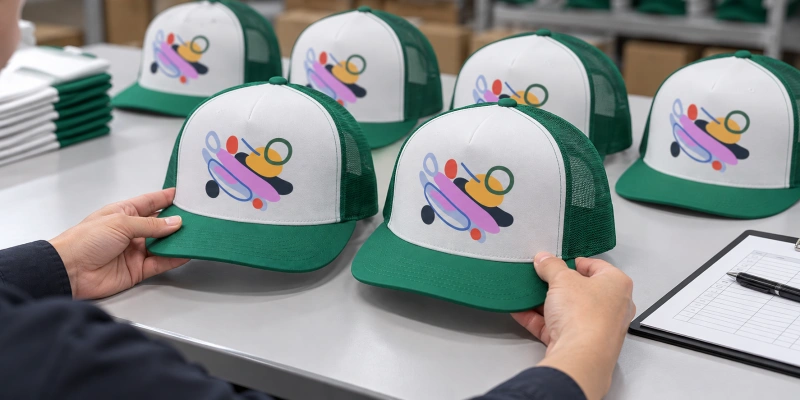
Once production units are available, compare actual caps from the relevant styles and colorways with the final approved version. If you are inspecting a sample of the lot, first agree which lots, cartons, sizes, and colors it represents and how units will be selected. A beautiful production cap that uses a different closure or smaller logo is still a departure from the approved order.
Use the matrix below to track consistency and departures across the order. The quick checklist tells you where to look on an individual cap; this matrix ties each bulk observation to its controlling approval and a decision.
| Feature | Approved Reference | Bulk Comparison | If Different |
| Material and color | Swatch, sample, material specification | Check fabric and panel shade by colorway | Identify affected colorway and request review |
| Crown and brim | Final sample and profile drawing | Compare shape in the same front and side views | Photograph both versions together |
| Logo size and position | Artwork version, decorated sample, landmarks | Check assembled cap; measure as specified | Record actual size and offset |
| Measurements and fit | Size chart, method, agreed tolerance | Measure selected units by size and style | Log values and affected units |
| Closure and labels | Approved components and label files | Test operation; verify content and placement | Identify wrong component or label revision |
| Pack and assortment | Packing instruction and purchase order | Match carton labels, quantities, color mix | Record carton IDs and count variance |
If the production sample differs from the signed-off version, do not approve it solely because the change seems minor. Decide whether to accept a documented deviation, request a correction and recheck, or withhold approval of the affected lot. A replacement sample or corrected units should be compared with the same written requirement.
Check Labels and Packing Before Shipment
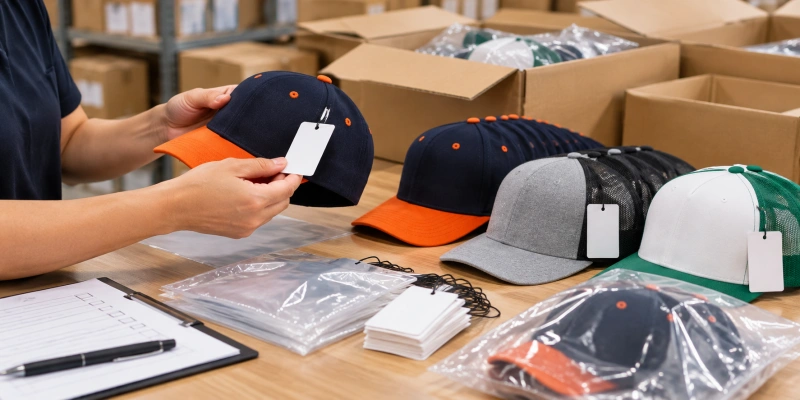
Inspect the brand label, care or content label, hangtag, and barcode only where your order calls for them. Verify approved wording and artwork, position, legibility, and the correct label on each style or colorway. A physical cap may be correct while its packaging carries the wrong SKU.
Check the count and color assortment against the purchase order, then compare individual packing, inserts, carton markings, and protection of the brim with the agreed packing instruction.
Record carton numbers for any mix-up so it can be located. If a destination market requires particular labeling or documentation, confirm the applicable requirements with a qualified party and obtain the exact order-specific evidence. This visual checklist does not establish regulatory compliance.
Record Defects and Agree on Acceptance Criteria
For each issue, record the style, colorway, size if relevant, carton or lot ID, number of units checked and affected, a clear description, the reference used, and dated photos. Include measurements and the measuring method when the issue is dimensional. Separate a disagreement about the specification from a workmanship fault; each needs a different correction.
Before inspection, agree with the supplier on the inspection stage, lot definition, sampling approach, measurement tolerances, defect categories, acceptance rules, and what happens after a failed check. Critical, major, and minor defects are useful categories only when the parties define which examples belong in each category for this order.
If you choose an AQL-based sampling plan, specify the applicable standard and edition, inspection level, AQL values, and handling of failed lots. AQL is a sampling-plan concept, not a promise that every delivered cap is defect-free. HENGXING’s published quality and compliance information describes factory checkpoints; this buyer checklist does not claim that HENGXING applies any particular AQL or fixed inspection ratio.
Ask for a response that identifies the affected scope, corrective action, and evidence of a recheck. If the same defect appears repeatedly, consider whether it is limited to one carton or colorway, or whether the broader lot needs review. Keep the approval decision tied to the agreed criteria and the corrected goods, not an unrecorded verbal assurance.
Common Quality Problems to Watch For
The most useful defect list is specific to your order. Typical visible problems include an off-center crown or brim, mismatched panel shade, uneven seams, a loose sweatband, embroidery that puckers the front, a misplaced logo, a closure that does not hold, or the wrong label or carton mix.
A soft unstructured front, a deliberately curved brim, and a contrast underbrim can all be correct if they match the approved design. Describe the actual departure and reference rather than labeling every different design choice “poor quality.”
Final Buyer Checklist Before Approval
- Confirm that the approved sample revision, specification, artwork, measurement method, and packing instruction agree.
- Check the relevant styles, colors, and sizes against those references, and document the lot or cartons reviewed.
- Log deviations with photos, measurements, counts, and a decision on correction or an agreed exception.
- Verify labels, assortment, carton marks, and packaging against the purchase order.
- Review corrected units or evidence and record the decision before approving the affected goods for shipment.
FAQs
How Can You Tell Whether a Baseball Cap Is Good Quality?
Start with the agreed design and inspect whether its materials, construction, decoration, fit, and finishing match the approved reference. Check for visible workmanship problems, but do not call an intentional style feature a defect. “Good quality” for a custom order means a usable cap that meets the agreed requirements consistently.
What Should You Check on a Custom Baseball Cap Sample?
Review the complete assembled cap: fabric, shade, crown and brim profile, logo at finished size, fit, closure, interior, labels, and any agreed packaging. Record open points and approve a specific revision together with its written specification. The sample alone cannot set tolerances or represent every size and color.
Which Baseball Cap Defects Matter Most in a Bulk Order?
That depends on the agreed defect categories and intended use. A wrong logo or label, unusable closure, open seam, persistent size discrepancy, or damaged cap may be more consequential than a small cosmetic difference. Define severity and acceptance criteria before inspecting the lot.
How Should You Compare Bulk Caps With an Approved Sample?
Use the same front, side, rear, and interior views; compare the same colorway and style; then measure the points named in the specification. Match logo placement, closure, labels, and packing to their separate written approvals. Record the number of units reviewed and any repeated variation.
How Do You Check Embroidery on an Assembled Cap?
Compare the finished logo size, position, thread colors, and legibility with the approved decorated sample. Look for incomplete areas, distorted letters, loose ends, and puckering. Inspect it on the worn or assembled cap, because the panel shape and seams affect how the mark appears.
Should You Inspect Caps Before Shipment?
Yes, if shipment approval depends on meeting your order requirements. Agree on when and how the inspection will occur, what lot it covers, and what evidence is needed to release or correct it. A pre-shipment check is most useful when the approved sample and written acceptance criteria are available.
Prepare Your Next Custom Cap Order
Bring your intended cap style, material and color references, artwork, size requirements, approved sample or reference photos, labels, and packing needs into one brief. If you are developing custom baseball caps, share that brief with HENGXING so the style, sample, and project-specific inspection requirements can be discussed before you authorize production.