
A PVC patch is a flexible molded badge made from polyvinyl chloride. Instead of forming a logo with thread, it uses a shaped surface with raised details, recessed lines, and distinct color areas. You can attach one to a hat, jacket, bag, or other item to create a separate, dimensional mark. PVC patches come in different shapes and relief styles, so the best choice depends on your artwork and the product that will carry it.
What Are the Key Features of PVC Patches?
What changes most from one PVC patch to another is the depth of the design, the feel of the surface, and the edge around it. Some logos have modest raised areas and clear outlines; others have deeper shapes and a more sculpted finish. The surface may be smooth or lightly textured.
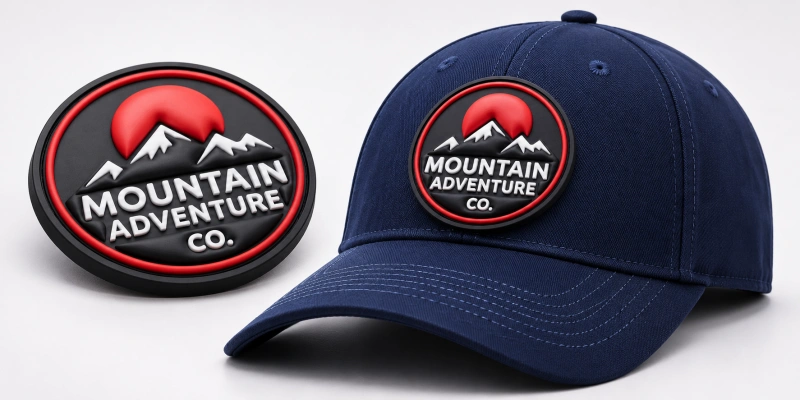
Flexibility also varies. A small, thin badge may follow a curved crown more easily than a large, thick one. The backing and border affect the finished feel as well. In the navy cap images, the full view shows how the round badge sits on the crown, while the close-up makes its raised colors and stitched edge easier to see.
[Image placement: patch hat2-1(4).jpg and patch hat2-4(4).jpg] Caption: The same round badge shown on the cap and in close-up. ALT: Round raised logo badge on a navy cap and close-up of its stitched border
A supplier may also call a molded badge a “rubber patch.” That name alone does not tell you what it is made of: PVC, silicone, and TPU can look similar but are different materials. If your specification requires PVC, confirm the material. Our guide to how PVC patches are made explains the production process.
2D vs 3D PVC Patches: What’s the Difference?
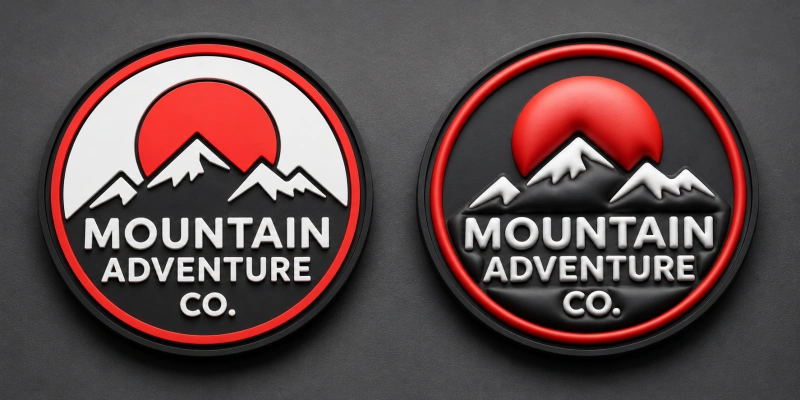
These terms describe the shape of the raised design, rather than the number of colors. A 2D patch is not completely flat: its design can sit at different heights, with relatively flat surfaces. A 3D patch has rounded or sloped contours. Both can use several colors. The better choice is the one that keeps your logo clear at its finished size.
| Design factor | 2D PVC patch | 3D PVC patch |
| Visible surface | Flatter areas at defined heights | Rounded or contoured relief |
| Useful starting point | Bold lettering and clear color blocks | Symbols or shapes that benefit from sculpted form |
| Sample check | Open spaces and readable outlines | Contours that remain clear from normal viewing distance |
Deeper relief does not automatically make small text easier to read. Check the design at actual size on a physical hat sample before choosing a sculpted version.
Advantages and Limitations of PVC Patches
PVC suits logos that need distinct color areas, a clear border, and a raised surface. The exposed face is often easier to wipe than a heavily textured thread patch. PVC itself does not absorb water like fabric or thread, although the finished hat still needs its own care assessment.
Small lettering, very thin lines, tight spaces inside letters, and photographic gradients may lose definition in a conventional molded design. A thick badge can also sit poorly on a soft or sharply curved crown. If you are considering heat application, the backing and hat fabric must be compatible with the process. For a design built around fine detail or a softer feel, compare a different patch material on the same cap.
PVC Patches vs Embroidered and Woven Patches
Each option creates a separate badge, but the finished texture and the kind of artwork it reproduces differ. Use this short comparison to decide which samples are worth requesting.
| Factor | Molded PVC | Embroidered patch | Woven patch |
| Look and feel | Smooth, raised color areas | Visible stitched texture | Flatter woven textile |
| Artwork fit | Bold blocks and dimensional marks | Thread-based logos with suitable line weight | Some finer text and flat details |
| On-cap check | Thickness, bend, and edge fit | Stitch clarity and border | Legibility, edge, and attachment |
No material preserves every logo equally. If the design depends on a soft textile look or very fine detail, compare embroidered or woven samples at finished size. If you want a defined molded surface, test PVC on the intended cap. For the broader decision between stitching and separate badges, read embroidery vs patches on hats.
What Are PVC Patches Used For?
PVC patches can carry brand marks, identifiers, or decorative graphics on jackets, backpacks, uniforms, outdoor gear, and removable patch panels. On a hat, the patch becomes part of the front or side profile, so its size and stiffness matter as much as its artwork.
PVC Patches on Trucker Hats
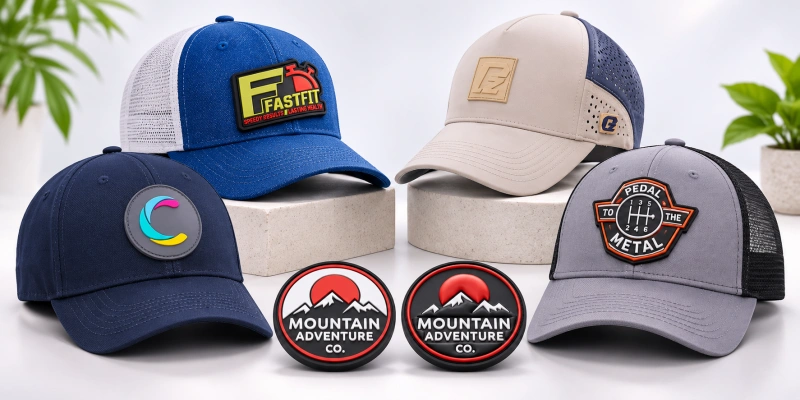
A trucker hat offers a prominent front above its mesh back. That front may be foam or woven fabric, with different firmness and responses to an attached badge. The gray mesh-back example shows how a raised, outlined mark stands out without covering the entire panel. When planning custom trucker hats, specify the front material as well as the logo. Confirm the badge material and attachment against the sample.
PVC Patches on Baseball Caps
A structured baseball cap can provide a supported area for a badge. A five-panel style often gives you an uninterrupted center front, while a six-panel style commonly has a seam through that area. Neither construction guarantees a better patch: the patch shape, seam thickness, actual crown curve, and chosen position determine the result. Check the front and side view of an assembled sample.
PVC-Style Badges on Performance-Style Hats
The supplied beige and gray caps show how a front badge and a smaller side mark can work together. On perforated or lightweight fabrics, check how the chosen badge sits and how it is attached. The photos do not establish whether these particular badges are PVC, silicone, or TPU; confirm the material before listing it in a product specification.
How to Choose a PVC Patch for a Custom Hat?
Look at your logo at the size it will appear on the hat. Can you read the smallest letters at a normal viewing distance? Are the spaces inside letters still open? If not, enlarge or simplify the mark, or compare a woven or printed patch. A large screen mockup can hide problems that become obvious on a real cap.
Choose 2D or 3D relief for a reason. Flat levels may keep bold lettering and color blocks distinct; rounded contours may help a symbol. Give the supplier your colors, outline shape, and intended placement, then review how the proposed size and thickness look on the cap. There is no single patch size that fits every crown.
The front panel matters as much as the badge. A firm five-panel front may support a wide mark that would sit awkwardly on a soft, low-profile cap. A center seam on a six-panel cap may affect symmetry or how the middle of the badge lies. Foam fronts should be assessed on their own because they can respond differently to pressure and heat than woven fabric.
Approve an assembled sample before bulk production. Check the logo at normal distance and close up, then inspect the border, corners, attachment, and crown shape from the side. If frequent wear or cleaning matters to your project, agree on suitable checks for that exact hat and patch combination.
FAQs
Are PVC Patches Waterproof?
The molded PVC face does not readily absorb water, but the finished hat is not automatically waterproof. Water can still pass through its fabric, seams, or the area around the attachment.
Can You Wash a Hat With a PVC Patch?
Follow the care instructions for the complete hat rather than washing it based on the patch material alone. If regular washing is expected, ask for a check on the finished cap and attachment.
Can PVC Patches Be Sewn or Heat Applied to Hats?
Yes, depending on the backing and cap fabric. Some patches can be sewn or heat applied; others use hook-and-loop backing so they can be removed. The choice needs to be tested on the intended hat. See how to attach a PVC patch to a hat for the methods and their limits.
How Are PVC Patches Made?
Artwork is translated into a mold, and the colored design is formed and finished. Our PVC patch production guide covers the steps in detail.
Custom PVC Patch Hats With HENGXING
If you are planning hats with a molded logo badge, send HENGXING your artwork, preferred cap style, quantity, and placement. We can review the decoration against the cap construction and develop a sample for approval. See our custom hat decoration options for the available approaches.