
A fitted hat has a closed back and comes in a fixed size. A snapback has a plastic snap closure that adjusts within a limited range. That is the main difference between a fitted hat and a snapback; either can have a flat or curved brim. For one wearer, the choice affects fit and the view from the back. For a brand, it also affects how many sizes to stock and what to check on a sample.

Fitted Hat vs Snapback at a Glance
| Feature | Fitted Hat | Snapback |
| Closure | No rear adjustment | Plastic snaps at the rear opening |
| Sizing | Choose a designated fixed size | Adjust within the range of that cap |
| Adjustability | Cannot change the circumference | Move between set snap positions |
| Back view | Continuous fabric panels | Visible opening and plastic fastener |
| Wearing | A set fit when the size suits you | Room to adjust when the fit changes |
| Stock planning | A size run creates separate SKUs | One adjustable SKU may serve more wearers |
| Useful for | A wearer who knows the right size and likes a closed back | Groups with mixed sizes or wearers who want adjustment |
What Is a Fitted Hat?
A traditional fitted cap has fabric across the back and no closure to adjust. You choose a numbered size based on your head measurement. The size label helps you start, but the crown shape and sweatband affect how the cap actually feels. The closed back also gives you an uninterrupted fabric area. See what a fitted hat is for more on this construction.
What Is a Snapback Hat?
A snapback uses interlocking plastic strips at the rear opening. Press them together at a different position to loosen or tighten the cap in steps. The closure can be paired with fabric or mesh panels and different crown shapes. If a cap looks like a snapback from the front, turn it around: it may use a strap or another fastener. Our snapback versus strapback guide shows how those closures differ.
Key Differences Between Fitted Hats and Snapbacks
Rear Decoration
The closed back of a fitted cap gives a designer continuous fabric around the rear, though a center seam may still affect embroidery. The opening on a snapback breaks up that area. If you want a logo at the back, check the usable space and seam position on the actual sample before placing the artwork.
Fit and Comfort
With a fitted cap, the circumference stays the same each time you wear it. A snapback lets you change the setting if you change your hairstyle, share the cap, or prefer a looser feel. Its adjustment happens in steps, so the closest setting may still feel too tight or too loose.
A good fit also depends on the crown depth and shape, not just the circumference. A fitted cap can press at the temples even when the size chart looks right. Tightening a snapback will not make a shallow crown deeper. Try the cap on and check that it stays centered without painful pressure or a large gap at the back.
Wear each cap at the height you normally prefer. If your hairstyle changes often, try it with the hair volume you usually have. Walk around and look down: does the cap stay in place without squeezing your forehead? A quick try-on while standing still may miss pressure that becomes obvious after a few minutes.
Fitted vs Snapback Sizing
Fitted caps are sold in designated sizes, commonly numbered in fractional steps. Measure around your head where the sweatband will sit and compare the result with the chart for the exact product. If your measurement sits between labels, trying adjacent sizes is more useful than assuming every manufacturer grades and shapes its caps identically. For detailed measurement steps and a reference chart, use our baseball cap size guide.
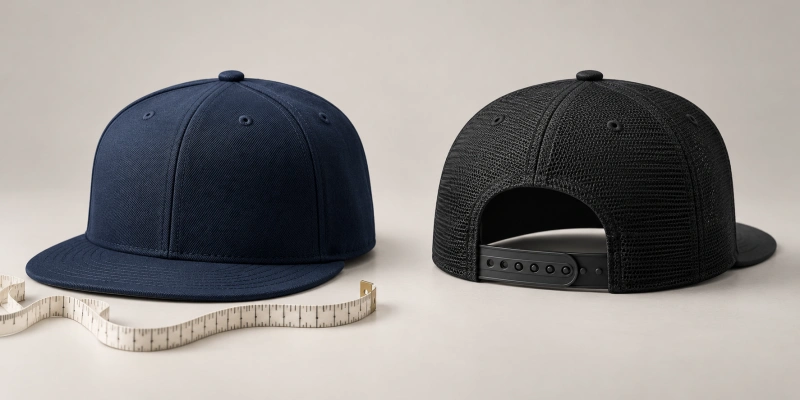
A label such as 7 1/4 is a fitted size, not a measurement of your head in inches. Use the maker’s chart to see the corresponding circumference. If you shop across brands, check each chart again instead of treating the same label as a guarantee of the same feel.
A snapback may carry a label such as “one size fits most,” but you need the fit range for that particular cap. Its pattern, back opening, sweatband, and closure all affect the range. Two snapbacks with the same number of holes can fit differently. If you are buying for a group, ask for the proposed style’s range and compare it with the head sizes of the intended wearers.
Can You Convert a Snapback Setting to a Fitted Size?
Not reliably. A snapback setting can give you a rough idea of fit, but there is no standard conversion to a fitted size. The position only tells you where the strips meet on that cap. Strap length, hole spacing, the rear opening, the crown pattern, and the sweatband can change the circumference.
If one snapback setting feels right, measure your head and check the fitted chart for the cap you want. Try the fitted size if you can. A snap position on a different hat is not enough to choose one.
Do Fitted Hats and Snapbacks Look Different?
The back is visibly different. From the front, however, the caps can look much alike. A flat brim and a tall, firm crown are often associated with snapbacks, but a fitted cap can have those features too. A snapback can have a curved brim and a lower crown.
Compare the brim, crown height, front support, and panel layout separately from the closure. Our baseball cap brim guide explains visor shapes, while structured vs unstructured hats cover front support. That way, you can tell whether you prefer the fit system or another part of the design.
Are Fitted Hats Better Than Snapbacks?
Neither is better for everyone. Choose a fitted cap if you know your size and like the closed-back look. Choose a snapback if you want to adjust the fit or share the design with people of different sizes. For a brand ordering for a mixed group, the snapback may also be easier to stock.
Your preference can change when you try the caps on. A fitted size that matches your measurement may still feel wrong if the crown shape does not suit you. A snapback offers adjustment, but only within its usable range, and you may dislike the rear opening or the feel of the snaps. Compare wearable samples rather than judging by a front photo.
Fitted vs Snapback for Brand Inventory Planning
Suppose your brand wants one logo and one color for a group. With fitted hats, each numbered size is a separate stock item. You have to estimate how many people need each size; otherwise, you may sell out of one while others remain. A team with a measured roster or a retailer with past sales by size can make a better estimate than a brand launching its first collection.
A snapback may cover more wearers with one size SKU. That can simplify stock and distribution for events or promotions when you do not know everyone’s measurements. It still has limits: a cap marked “one size” will not fit every person, and the crown may sit differently at the tightest and loosest settings. Compare the actual range with your audience before you order.
Color and age groups still need separate planning. Each colorway has its own stock, and an adult snapback does not automatically fit a child just because both have plastic snaps. Tell your supplier who will wear the caps, which head sizes the order should cover, and whether you want one adjustable size or a measured size run.
Sample Approval and Quality Checks
Try a physical sample on the intended wearers. A front photo cannot show whether the crown is deep enough, the sweatband presses, or the brim sits straight. Keep the agreed measurements and fit range beside the approved sample so you can check the finished order against the same reference.

| Check | Fitted Sample | Snapback Sample |
| Size and fit | Compare finished fit across the specified sizes; check consistency between samples | Try the intended minimum, middle, and maximum settings; observe the fit at each |
| Rear construction | Inspect closed-back seam and rear artwork alignment | Check opening symmetry and how the plastic tabs engage and release |
| Shared checks | Crown shape, visor position, stitching, sweatband, logo placement, and finish | Crown shape, visor position, stitching, sweatband, logo placement, and finish |
For fitted caps, check more than one size if the order spans a size run. For snapbacks, try the middle and both ends of the intended adjustment range. A single good-looking sample does not answer either fit question.
What About Stretch-Fit Hats?
A stretch-fit cap has a closed back, but stretch in its fabric or sweatband lets it fit a limited size range. It does not have a plastic snap closure. If you like the closed-back look but do not want one exact fixed size, try a stretch-fit sample. Check its stated range just as you would for an adjustable cap. “Stretch-fit” is the general term; some brands also sell their own versions under trademarked names.
Which Should a Brand Choose?
Decide which rear construction your customers want, then check whether your size information supports that choice. Write the crown shape, brim, fabric, artwork, and fit range into the brief separately. Before ordering, have the intended wearers try the finished construction rather than relying on a style name alone.
If an adjustable plastic closure suits your project, explore HENGXING’s custom snapback hats. Share your reference cap, artwork, quantity, intended wearers, and preferred crown and brim so the team can review the proposed snapback design.
FAQs
What Is the Main Difference Between a Fitted Hat and a Snapback?
The back and sizing system tell them apart: fitted caps use a selected fixed size, while snapbacks adjust with plastic snaps. Check the rear of the actual cap if the product photo only shows the front.
Are Snapbacks One Size Fits All?
No. “One size fits most” still has limits. Check the stated range for the specific model, especially if someone in your group is near either end.
Can I Determine My Fitted Size From a Snapback?
Use it only as a rough clue. Measure your head and check the fitted size chart for the cap you want; the snap position on another model has no fixed equivalent.
Do Fitted Hats Fit Tighter Than Snapbacks?
No. A fitted cap in the right size may feel comfortable, while a snapback tightened too far can press. Crown depth and sweatband shape matter too.
Are All Fitted Hats or Snapbacks Flat Brim?
No. Both can have flat or curved brims. Look at the rear closure to tell the two sizing systems apart.
What Is the Difference Between Fitted, Snapback, and Stretch-Fit Hats?
A traditional fitted cap has a closed back and a fixed size. A snapback adjusts at an open back. A stretch-fit cap keeps the closed back but stretches across a stated size range.