
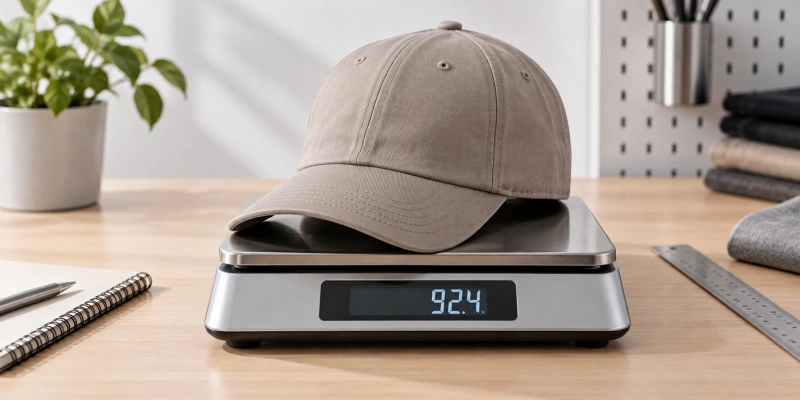
A baseball cap has no single standard weight. Published specifications for individual caps in the table below run from 29 g (about 1.0 oz) for a minimal running cap to 94 g (about 3.3 oz) for a five-panel cotton style. That is a range across selected products, not an industry average.
Fabric, crown construction, brim, closure, and decoration all contribute to the finished weight. For an order specification, weigh the exact approved sample without packaging and record the result in grams.
Baseball Cap Weight: Published Product Examples
These are weights stated on the brands’ product pages, checked October 15, 2026. They have different designs and are not controlled test samples. The ounce column below converts the published gram figure using 1 oz = 28.3495 g; a brand may round its own ounce figure differently.
| Product and published specification | Construction / material context | Weight (g) | Calculated weight (oz) |
| Janji AFO Hyperlight Cap | Low-profile running cap; stretch synthetic fabric; foam brim | 29 | 1.02 |
| Patagonia Fitz Roy Icon Trad Cap | Unstructured, six-panel; organic cotton canvas crown | 85 | 3.00 |
| Patagonia Airfarer Cap | Unstructured, five-panel; cotton canvas front and mesh back | 88 | 3.10 |
| Patagonia P-6 Logo Trucker Hat | Trucker construction; material and components on linked listing | 91 | 3.21 |
| Patagonia P-6 Label Maclure Five-Panel Hat | Five-panel style; cotton canvas or corduroy varies by color | 94 | 3.32 |
The endpoints show how widely specific designs can differ. They do not establish that every baseball cap falls between 29 and 94 g. The 29 g model is purpose-built for running, while the other listings have different fabrics and components. Product-page weights may also change with a revised style or variant, so check the exact item before using a number in a purchase order.
What Is the Average Weight of a Baseball Cap?
There is no single standardized average weight across all baseball caps. A meaningful average needs a defined population: which styles, sizes, fabrics, closures, and decorations are included, how many units were weighed, and whether the figure describes a bare cap or a packaged item.
Taking the arithmetic mean of the five unrelated listings above would describe only those five selected products. It would not tell you the average weight of a baseball cap in general.
For your own product line, use an approved sample as a provisional estimate, then weigh several production units when available. Record the sample count and the spread as well as the mean. If your aim is a shipping calculation, confirm packing materials and carton configuration separately. A supplier’s product description or a broad “lightweight” label cannot replace a measured specification.
What Makes a Baseball Cap Heavier or Lighter?
Fabric and Crown Construction
Fabric composition alone is an unreliable shortcut. A heavier cotton canvas, a light synthetic weave, a mesh back, and a multilayer front differ in fabric weight, coverage, and finishing. A fabric’s listed ounces per square yard describes the material, not the total weight of the assembled cap.
You also need to account for lining, seams, and other components. See the separate guide to baseball cap materials if you are deciding which fabric suits the intended use.
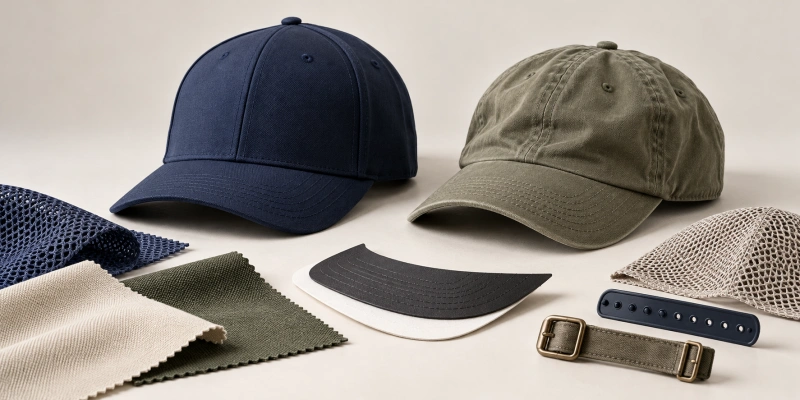
A structured crown may add a support layer, such as buckram, behind its front panels. That layer adds material to an otherwise comparable cap, but it does not prove every structured cap is heavier than every unstructured one. Fabrics and other components can outweigh the effect of reinforcement. Our structured vs. unstructured hat comparison explains their appearance and construction in more detail.
Panels, Brim, and Smaller Components
Panel count describes how the crown is assembled; it is not a weight rating. A five-panel cap can be heavier than a six-panel cap when its fabric, brim, or trim differs. Compare the same fabric and component specifications if you want to isolate a panel change. The five-panel vs. six-panel hat guide covers the shape and layout distinctions.
The brim can contain a molded insert or another reinforcing material, with fabric wrapped around it. Sweatbands, seam tape, eyelets, labels, top buttons, and back closures each add to the finished assembly. A metal buckle and a plastic snap are different components, but you cannot assign a universal gram difference without weighing the chosen hardware. For a component overview, see the parts of a baseball cap.
Embroidery, Patches, and Accessories
Embroidery adds thread and sometimes backing; a patch adds the patch and its attachment. Logo size, stitch density, patch material, and backing method vary, so a fixed “embroidery adds X grams” rule would be misleading. Measure a plain sample and a decorated sample with otherwise identical specifications if that difference matters to your target.
Any hangtag or removable retail accessory should be recorded separately from bare-cap net weight.
Baseball Cap Weight in Grams, Ounces, and Kilograms
Grams are practical for individual caps because the figures stay readable without many decimals. For conversion, divide grams by 28.3495 to get ounces, or divide by 1,000 to get kilograms. For example, the published 85 g Fitz Roy Icon Trad Cap is 3.00 oz or 0.085 kg; the published 29 g Janji cap is 1.02 oz or 0.029 kg.
Those are conversions of the listed product weights, not new measurements. One kilogram equals 1,000 g, and one ounce equals approximately 28.35 g.
Keep the original unit and source when you compare listings. Patagonia displays the 85 g cap as 3 oz, and Janji displays 29 g as 1 oz; rounding explains the small difference from the calculated figures. If a source gives only ounces, multiply by 28.3495 to estimate grams and label the result as a conversion. Do not present a converted value with more precision than the original specification supports.
Net Weight vs. Packed and Shipping Weight
A cap’s net weight is the weight of the cap itself under the stated measurement condition. Packed weight includes the cap plus its individual bag, inserts, tags, or protective materials. Carton-level gross weight also includes the outer carton and any fillers. Carriers may charge by actual gross weight or dimensional weight under their service rules, so a bare-cap figure alone is not a freight quote.
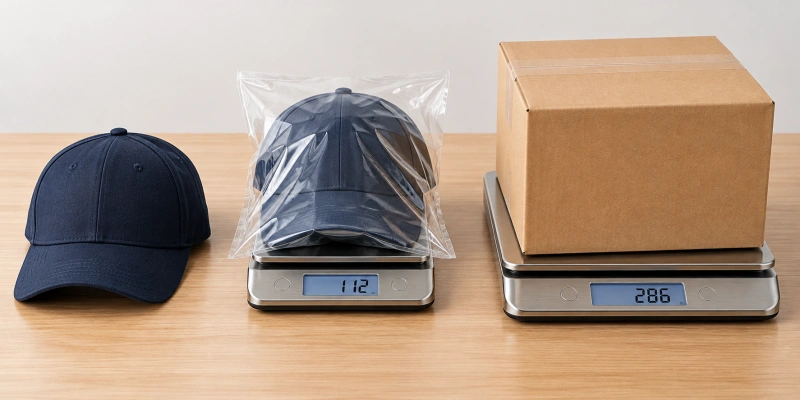
For example, multiplying a verified 85 g cap by an order quantity estimates the caps’ combined net weight only. It does not tell you the final number or size of cartons, packaging mass, or billable carrier weight. Confirm the packing plan, carton count, and measured gross weight before finalizing shipping estimates. The practical packing process belongs in how to ship a baseball cap.
How to Estimate Weight for a Custom Baseball Cap Order?
Start with one clear construction specification: fabric and its weight, crown structure, panel layout, brim insert, sweatband, closure, logo treatment, size range, and any permanent trims. A change to one of these can change the final cap. Your target weight should therefore sit alongside the visual and fit requirements, not replace them. If you need head circumference or fit dimensions, use the separate baseball cap sizes guide.
Once you approve a sample, weigh it on a calibrated or checked digital scale in grams. Remove removable packaging and note whether attached tags remain part of the agreed net-weight definition. Tare the empty scale, place the dry cap on it, and repeat the reading.
Record the style, size, materials, logo, closure, date, scale resolution, and all readings. For a repeatable comparison, keep the same weighing conditions across samples. If your specification allows a tolerance, agree on that tolerance and the inspection method before production.
For order planning, multiply the verified sample weight by the quantity as an initial net-weight estimate. Then request the proposed units per carton, the individual packaging specification, carton dimensions, and a packed-carton gross-weight measurement.
This separates product selection from logistics and lets you revise either estimate when a logo, fabric, or packing choice changes. It also gives you a useful reference for checking later production batches.
FAQs About Baseball Cap Weight
How Much Does a Baseball Cap Weigh in Grams?
It depends on the exact design. The selected published examples above range from 29 g for a minimal running cap to 94 g for a five-panel style. That range is not a universal specification. Weigh your actual cap or approved sample for a usable number.
How Many Ounces Does a Baseball Cap Weigh?
Divide its measured grams by 28.3495. An 85 g published product weight converts to about 3.00 oz. Other constructions may be much lighter or heavier; check the specific product.
Does a Structured Baseball Cap Weigh More?
Added front reinforcement contributes material, but the total depends on the fabric, brim, closure, and trim. Compare matched samples before attributing a weight difference to structure.
Does Embroidery Affect Baseball Cap Weight?
Yes, thread and any backing contribute to weight. The amount depends on the actual design and application. A matched plain and embroidered sample can show the difference for your order.
Is Cap Weight the Same as Shipping Weight?
No. Packing materials and cartons add mass, and carrier billing can also depend on package dimensions. Request a measured packed-carton gross weight for a shipping estimate.
Confirm the Weight of Your Custom Cap
If you are developing custom baseball caps, share the target fabric, crown shape, closure, and logo details with HENGXING. Ask for the completed sample’s measured net weight and a separate packed-carton estimate for your chosen order configuration. That gives you a specification you can check before committing to production or freight planning.