
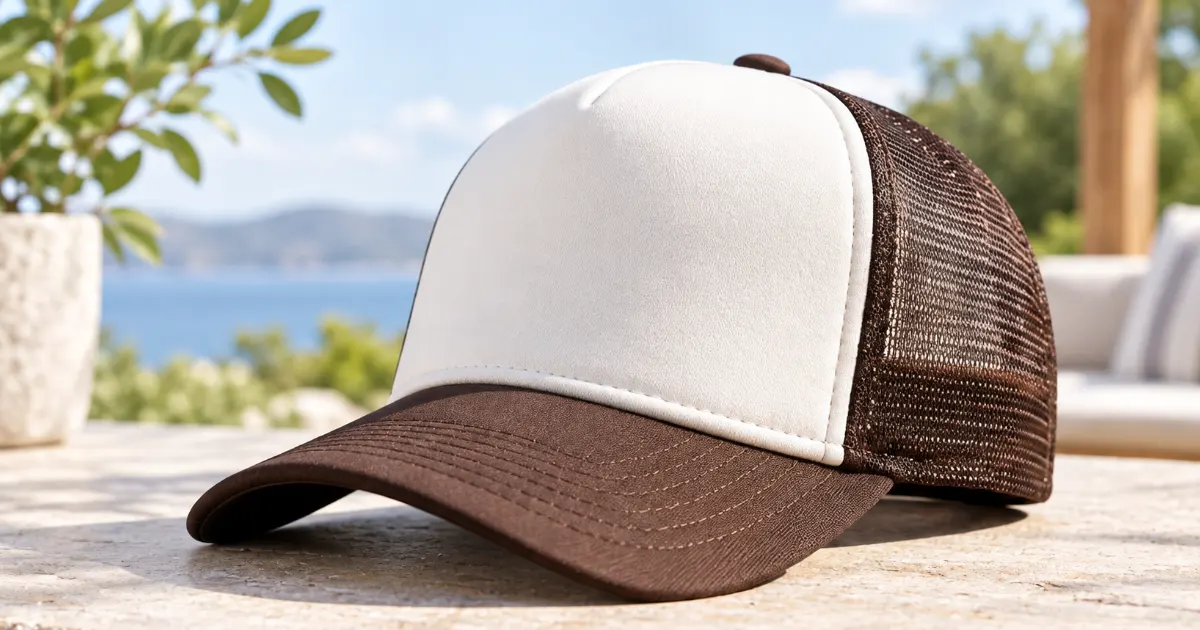
An A-frame hat is a baseball-style cap with a tall, shaped front that narrows or pinches toward the top center. Instead of a vertical seam dividing the front into two equal panels, many A-frame crowns use one broad front panel with a dart or shaped seam near the top. The result is an uninterrupted decoration area and a distinct peaked profile when viewed from the side.
The term describes front-crown geometry. It does not automatically mean the hat is a snapback, trucker, five-panel or flat-brim cap. Those features often appear together, which is why the labels get mixed up, but each describes a different part of the construction.
Why Is It Called an A-Frame Hat?
From the front, the upper crown tapers toward a central peak, creating lines that suggest the sides of the letter A. From the side, the front tends to rise more steeply than a relaxed dad hat and then angles back toward the crown.
The visual effect comes from pattern shape, seam placement and support—not from a literal A-shaped insert. Some versions have a clear pinch at the upper front, while others use a softer taper. “A-frame” is therefore a useful category, but dimensions are still needed when exact shape matters.
How an A-Frame Crown Is Constructed
A conventional six-panel baseball cap has a vertical center-front seam where two front panels meet. An A-frame commonly replaces that pair with a broad single front section. A dart or short seam closes excess fabric near the top so the flat panel can form a three-dimensional crown.
| Construction element | What it does | Why it matters |
| Broad front panel | Creates a large uninterrupted face | Avoids a full vertical seam through the center of a logo |
| Top dart or pinch | Shapes the panel into a peaked crown | Controls taper, height and the characteristic A-frame line |
| Front support | Helps the crown stand away from the forehead | Determines how crisp or relaxed the shape appears |
| Side panels | Connect front geometry to the back | Affect depth, head shape and side profile |
| Top button, if used | Covers or finishes the crown intersection | Must sit centrally despite the nonstandard front seam layout |
| Sweatband | Defines the opening and supports fit | Influences circumference, pressure and stability |
Not every maker uses the same panel count or dart. Some A-frame designs are classified as five-panel caps because the front is one panel; others are built from a different combination of front, side and rear sections. The finished geometry is more reliable than panel-count shorthand.
What Does an A-Frame Hat Look Like?
The typical silhouette has a prominent front, a visible taper toward the top and more space above the forehead than a low-profile unstructured cap. The front panel may appear almost triangular at the upper crown, although the lower part remains wide enough for decoration.
Viewed head-on, the brim usually centers beneath a single expanse of fabric. Viewed from the side, the front line rises sharply and the crown transitions backward. A stiff backing makes these lines crisp; a softer backing allows the peak to settle and conform.
Is an A-Frame Hat High Profile?
Many A-frame hats are high or mid-high profile because the tall front makes the shape distinctive. However, profile is a measurement and proportion, not an automatic consequence of the name. A shorter A-frame pattern can retain the central taper while sitting lower on the head.
Three dimensions are worth separating:
- Front height: The distance from the lower front edge to the upper crown.
- Crown depth: How far the hat settles down the sides and back of the head.
- Front angle: How steeply the face rises away from the brim.
A tall front does not always mean a deep fit. A cap can look high from the front yet feel shallow at the back if the rear panels are short. Product photos rarely reveal all three dimensions.
How Should an A-Frame Hat Fit?
The sweatband should make even contact without pinching, while the front crown should stand in its intended position rather than collapsing onto the forehead. The top pinch should center above the bridge of the nose, and the brim should not pull to one side.
Forehead room
Structured A-frame fronts often sit slightly away from the forehead. That creates a bold outline and room for front decoration, but too much space can make the crown feel disconnected from the head. Too little space can flatten the peak or cause the front panel to bulge.
Crown depth
If the crown is too deep, the lower edge may press on the ears and the brim may sit close to the eyebrows. If it is too shallow, the cap rides high and can lift in wind. Adjusting the rear closure changes circumference but cannot fully correct the wrong crown depth.
Head shape
A tapered A-frame may suit one head shape and create side gaps on another. The internal oval, front angle and rear-panel curve all affect the fit. Try the cap from the front and side rather than judging only by head circumference.
A-Frame Hat vs Five-Panel Hat
The categories overlap but are not identical. “Five-panel” counts the major crown panels. “A-frame” describes the shape and seam logic of the front crown.
| Question | A-frame hat | Five-panel hat |
| What defines it? | Tapered or pinched front-crown geometry, commonly with one broad front panel | A crown constructed from five main panels |
| Front shape | Usually tall and peaked | Can be tall, low, flat-fronted or softly shaped |
| Center-front seam | Usually no full vertical seam | Often absent, but construction varies |
| Brim | Flat or curved | Flat or curved |
| Closure | Any compatible closure | Any compatible closure |
An A-frame may use five panels, but not every five-panel cap has the A-frame’s raised, pinched front. A low-profile camp cap is also commonly a five-panel design and has a very different silhouette.
A-Frame Hat vs Trucker Hat
A trucker hat is identified mainly by its mesh rear panels and characteristic cap construction. An A-frame is identified by the front crown. A product can be both: it may have an A-frame front, foam or woven front material, mesh sides and back, and a snap closure.
Solid-back A-frame hats also exist. Likewise, not every trucker hat has an A-frame front; some use a center-seamed two-panel front or another high-crown pattern. Look at front construction and rear material separately.
A-Frame Hat vs Snapback
A snapback has two plastic tabs that snap together at the rear. An A-frame may use those tabs, but it may also be fitted or adjusted with a fabric strap, elastic or buckle. “Snapback” answers how the size changes; “A-frame” answers how the front is shaped.
This distinction prevents a common specification error. Asking for an A-frame does not communicate the closure. Asking for a snapback does not communicate the crown geometry.
A-Frame Hat vs Standard Six-Panel Baseball Cap
| Feature | A-frame | Conventional six-panel |
| Front seam | Broad front panel, often with only an upper dart | Vertical center seam from brim to top |
| Front silhouette | Peaked or pinched | More evenly rounded or divided |
| Decoration surface | No long center seam through most front artwork | Artwork crosses or works around the center seam |
| Panel count | Varies, often associated with five-panel layouts | Six primary crown panels |
| Typical profile | Often tall or mid-high | Available from low to high |
Does an A-Frame Hat Have a Flat Brim?
It can, but a flat brim is not required. The crown can be paired with a flat, pre-curved or shapeable brim. A curved brim softens the visual width and follows the face more closely. A flat brim emphasizes the tall angular front.
Brim length, width, insert stiffness and set angle all affect how the crown appears. An oversized flat bill can make the same crown look shorter, while a narrower curved bill may make it look taller.
Structured vs Unstructured A-Frame Hats
Structure usually comes from buckram, foam, laminated fabric or another supporting layer behind the front panel. A structured A-frame keeps the peak visible when it is not being worn and provides a stable decoration surface.
An unstructured version uses little or no rigid front support. It can still have an A-frame pattern, but the front will conform more closely to the head and the pinch may look softer. If you want the classic bold peak, material and support level must be specified along with the pattern.
Materials Used in A-Frame Hats
| Material | Effect on the design | Common consideration |
| Cotton twill | Classic texture and balanced structure | Weight and washing can change how sharply the front holds |
| Polyester woven fabric | Consistent shape, color and potential quick-drying construction | Hand feel and airflow depend on weave and backing |
| Foam-laminated front | Creates a bold, lightweight front face | Heat, creasing and delamination need consideration |
| Wool blend | Substantial traditional cap appearance | Care and heat exposure can affect size |
| Mesh rear panels | Add open area and trucker styling | Stretch, snagging and the transition to the solid front |
| Performance stretch fabric | Allows a closer athletic fit | Stretch direction must coordinate with sweatband and panel seams |
Why the Front Panel Works Well for Decoration
The missing vertical center seam creates a broad field for embroidery, patches, transfers or prints. That reduces the risk of a seam splitting fine artwork at the center. It does not create a perfectly flat canvas: the panel still curves around the head and narrows toward the dart.
Embroidery
Artwork should account for crown curvature, backing stiffness and the upper pinch. Dense stitching near the dart can pull the front out of shape. The usable area is generally wider lower on the panel than near the top.
Patches
Woven, embroidered, leather-like and molded patches can suit the uninterrupted face. Patch size and stiffness should follow the front curve; an overly rigid patch may bridge away from the crown edges.
Printing and heat transfer
A smoother single panel can simplify placement, but temperature and pressure must suit the fabric, coating, foam or backing. The crown needs stable support during application so the image remains level.
Who Is an A-Frame Hat For?
Choose this shape if you prefer a prominent front crown, visible height and an uninterrupted logo area. It works for streetwear, sport-inspired collections, trucker hybrids, event headwear and casual uniforms.
It may be less suitable if you want a cap that disappears close to the head, folds easily into a pocket or has a soft dad-hat silhouette. A pronounced A-frame is intentionally visible; that is the design’s strength and its main styling commitment.
How to Choose an A-Frame Hat
- Check the front view and side view. You need both to understand taper, height and angle.
- Confirm the panel layout. Do not assume every five-panel hat is an A-frame or vice versa.
- Specify structure. Decide whether the peak should remain crisp off the head or soften during wear.
- Measure depth and circumference. Rear adjustment cannot correct an unsuitable crown depth.
- Choose brim geometry independently. Flat and curved brims create different proportions.
- State the closure. Snap, strap, fitted and stretch-fit options are separate from the crown.
- Plan decoration around the dart. Use the broad area, but respect its taper and curvature.
Common A-Frame Quality Issues
- Off-center pinch: The dart, brim and top button do not align.
- Front collapse: Support is too soft for the intended tall profile.
- Panel bubbling: Outer fabric and backing shrink or feed differently.
- Uneven side taper: Side panels pull the peak toward one side.
- Brim misalignment: The bill is not centered beneath the single front panel.
- Decoration distortion: Dense artwork pulls the panel or crosses too close to the dart.
- Fit imbalance: The front looks tall while the rear is too shallow to hold the head.
Care and Shape Retention
Follow the care label. A structured A-frame should not be crushed or exposed to uncontrolled heat. Spot cleaning is often less risky than full immersion, but permitted care depends on shell fabric, backing, brim insert and decoration.
Air-dry the cap in its intended shape. Do not flatten the front peak under other items. If the brim is shapeable, adjust it gradually with both hands so pressure remains symmetrical.
Frequently Asked Questions
Is an A-frame hat a five-panel hat?
Many A-frame hats use a five-panel layout, but the terms are not identical. Five-panel refers to panel count; A-frame refers to the peaked front construction.
Is an A-frame hat a trucker hat?
Only when it also has the mesh-back features of a trucker. Solid-back A-frame hats exist, and many trucker hats use a different front construction.
Are A-frame hats always snapbacks?
No. Snapback is a closure type. An A-frame can use snaps, a fabric strap, a fitted size or a stretch-fit system.
Do A-frame hats fit higher?
They often have a taller front, but actual depth and profile vary. Check measurements and side-view shape instead of relying only on the category name.
Can an A-frame hat have a curved brim?
Yes. Brim curvature is independent of crown construction.
Why is an A-frame good for logos?
The broad front usually has no full vertical center seam, so artwork does not need to cross that seam. The panel is still curved and tapered, which limits usable size.
What head shape suits an A-frame?
There is no universal head shape. The cap’s internal oval, depth and front angle need to match the wearer. People who like forehead room and a visible front often prefer the silhouette.
Final Takeaway
An A-frame hat is defined by its tall, tapered or pinched front crown, commonly built from one broad front panel with an upper dart. Panel count, brim, closure, mesh and structure remain separate choices. If you evaluate those attributes individually, you can distinguish a true A-frame from a generic five-panel, trucker or snapback and choose the fit deliberately.
For custom A-frame development, HENGXING can help coordinate crown geometry, support, brim, closure and decoration placement into one workable specification.