
A dad hat is a relaxed baseball-style cap with a soft crown, low profile, curved visor, and usually an adjustable fabric strap. It sits close to your head and bends around it instead of holding a tall, rigid front.
The name describes a familiar style rather than a strict technical standard. Most dad hats share the same feature bundle, but panel shape, crown depth, fabric, closure, and fit still vary. That is why two hats carrying the same label can feel very different once you put them on.
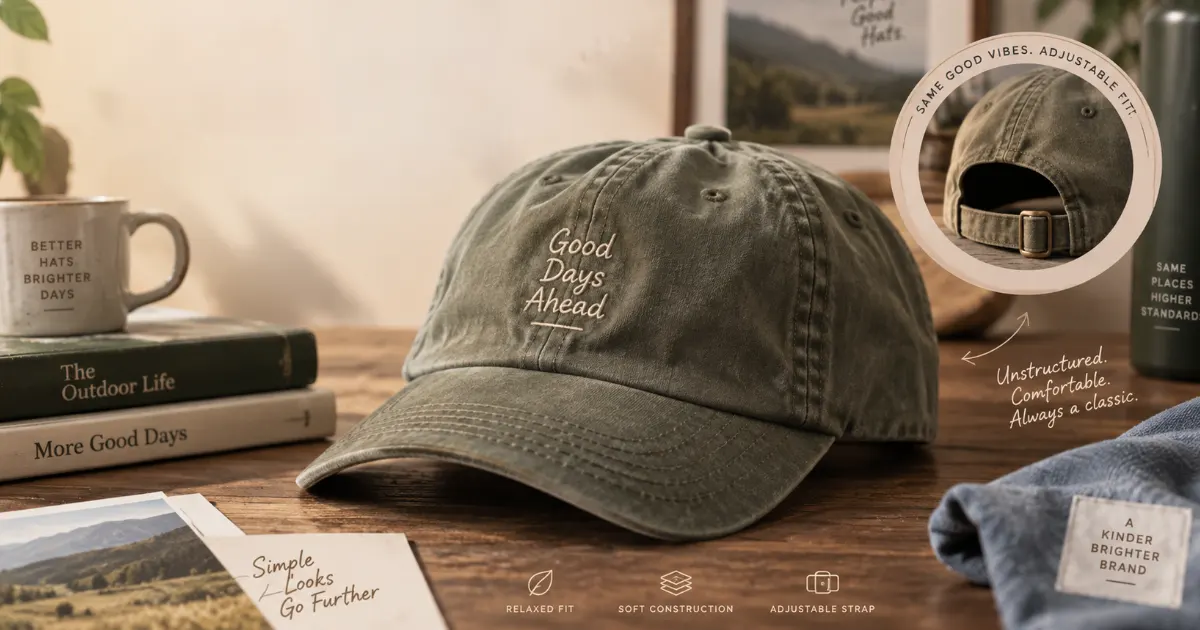
Dad Hat Features at a Glance
| Feature | Typical dad hat | Possible variation |
|---|---|---|
| Crown structure | Unstructured and soft | Light or partial support |
| Profile | Low and close to the head | Different depths and front slopes |
| Panel layout | Usually six panels | Five-panel versions also exist |
| Visor | Pre-curved | Curve, length, width, and stiffness vary |
| Closure | Fabric strap with buckle or slider | Leather strap, hook-and-loop, or plastic buckle |
| Material | Cotton twill, often washed | Denim, corduroy, polyester, nylon, and blends |
Why Does a Dad Hat Look So Relaxed?
The front panels usually do not contain stiff buckram. Buckram is the firm backing that helps a structured cap stand upright. Without it, the shell fabric can fold when the hat is off your head and settle into a softer curve when you wear it.
That softness is the point. It gives a dad hat its broken-in, unfussy appearance. Unstructured does not mean shapeless or poorly made, though. Panel geometry, fabric weight, seam tension, and pressing still decide whether the crown drapes evenly or twists to one side.
Profile is a different idea. “Unstructured” tells you about support; “low profile” tells you about crown height and depth. They often appear together in dad hats, but they are not interchangeable. The difference is easier to see in the structured vs unstructured hat guide.
How Should a Dad Hat Fit?
A dad hat should rest close to the top of your head without a large pocket of empty fabric above it. The sweatband should feel secure but not press hard at the temples, and the curved visor should sit naturally rather than being pushed upward by the crown.
The rear strap adjusts circumference, but it cannot add crown depth. If the hat feels tight only around the band, loosening the strap may solve the problem. If it rides high, pulls upward at the back, or will not reach the top of your head, the crown shape is probably too shallow for you.
Low profile is not another way to say “for small heads.” A larger head can suit a shallow silhouette, and a smaller head can need more depth because of head shape or hair. The useful test is how the crown meets your head, not the size category printed on the label.
Dad Hat vs Baseball Cap, Snapback, and Trucker Hat
| Style | Typical crown and visor | Typical back | Overall feel |
|---|---|---|---|
| Dad hat | Soft, low crown with curved visor | Adjustable fabric strap | Relaxed and understated |
| Baseball cap | Any structure, profile, or visor shape | Adjustable, fitted, or stretch-fit | Broad category rather than one construction |
| Snapback | Often firm with a flat or slightly curved visor | Plastic snap closure | More defined, though soft versions exist |
| Trucker hat | Solid or foam front with mesh sides and back | Usually adjustable | Airier with a visible mesh-back identity |
A dad hat belongs to the baseball-cap family, but not every baseball cap has the relaxed dad-hat combination. The dad hat vs baseball cap comparison goes deeper into that boundary.
The Curved Visor Matters More Than It Seems
The visor is usually pre-curved, which means the shape is already formed before you wear the cap. It frames the face and visually continues the close, rounded line of the crown. A flatter visor can make the same soft cap look wider and less recognizably “dad hat.”
Curve is only one variable. Visor width, length, board stiffness, and the angle where it meets the crown change both appearance and comfort. A very narrow curve may press near the temples, while a long visor can dominate a shallow crown. The best proportion is the one that looks balanced from both the front and side.
Common Dad Hat Materials
Cotton twill is the classic choice. It has a matte surface, familiar hand, and enough body to form a soft crown without feeling flimsy. Heavier twill feels more substantial; lighter twill folds and drapes more easily.
Washed or pigment-dyed cotton creates softened color and a worn-in surface. “Washed” describes a finish, not the fiber itself. The treatment may make seams and edges look lighter, and small differences in shade can be part of the intended vintage effect.
Denim and corduroy add visible texture. Denim can show contrast at seams after washing, while corduroy ribs can break up fine lettering. Both give the cap more visual weight than plain twill.
Polyester and nylon can create smoother, lighter, or more technical-looking versions. The fiber name alone does not guarantee moisture wicking, quick drying, water resistance, or UV protection. Those depend on the fabric and finish. The hat materials guide explains those distinctions.
Closures: Strapback Is Typical, Not Mandatory
Most dad hats use a fabric strap with a metal buckle or sliding adjuster. The strap often feeds into an opening or tunnel so the loose end does not hang down. This keeps the rear looking soft and simple.
Leather straps, plastic buckles, and hook-and-loop closures can create the same adjustable function with a different feel. A plastic snap is possible too, although it shifts the visual language toward a snapback. Whatever the closure, check whether the hardware lies flat and whether excess strap rubs or bunches at smaller settings.
Logo and Decoration on a Soft Crown
Flat embroidery suits the low-key character of a dad hat and works well for many small-to-medium logos. Because the front fabric is not held rigid, very dense stitching can pull the panel inward or create ripples around a filled shape.
Raised embroidery can work when the artwork uses bold forms and the crown offers enough support and vertical space. It is less forgiving with narrow strokes and tiny gaps. The practical differences are covered in the flat embroidery vs 3D puff comparison.
Woven patches can retain fine detail, while leather or rubber patches add more stiffness and thickness. A large rigid patch may bridge over the curved crown or touch the visor on a shallow front. Printing keeps the surface lighter, but the ink or transfer must suit the fabric texture and finish.
How to Choose a Dad Hat
If you want the classic look, start with an unstructured low crown, a pre-curved visor, and a fabric strap. Then choose fabric by the way you want the hat to feel. Washed twill looks softer and more lived-in; corduroy feels more textured; lightweight nylon creates a cleaner outdoor or travel direction.
Try the hat at your normal strap setting and look at it from the side. The crown should meet the top of your head without forming a tall peak, and the back should not pull upward. If the fit is right but the cap still looks too stiff, the issue is likely front support or fabric body rather than size.
How Head Shape and Hair Change the Fit
A soft crown adapts more readily than a firm one, but it still follows a fixed pattern. Someone with a long-oval head may feel pressure at the front and back while the sides remain loose. A rounder head may need more width through the side panels. The adjustable strap changes the lower circumference without changing either shape.
Hair can take up enough crown volume to change the way a dad hat sits. Thick curls, braids, or a ponytail may lift the back or keep the crown from reaching the top of the head. A larger rear opening can help with some hairstyles, but opening the strap too far may distort the panels around it.
| What you feel or see | Possible reason | Useful comparison |
|---|---|---|
| The hat rides up | Crown is too shallow or hair needs more room | A deeper low-profile pattern or slightly higher side panels |
| The front collapses awkwardly | Fabric is very soft or crown volume is too large | A lighter support layer or closer-fitting pattern |
| Pressure near the temples | Crown width or sweatband is too tight | A broader crown, not only a looser strap |
| The back opening spreads widely | Closure is near its largest useful setting | A larger base circumference or different size range |
| The visor sits too low | Crown is deep or front angle is steep | A shallower pattern or adjusted visor position |
Washed Finishes, Fading, and Color
The faded look of many dad hats comes from garment washing, pigment dyeing, enzyme treatments, abrasion, or a combination of processes. The result can soften both color and hand, especially around raised seams, visor edges, the back opening, and the top button.
Variation is part of the appeal, but not every washed hat should look heavily distressed. A light wash may simply remove the crispness of new twill. A stronger vintage finish can create clear high and low areas, while abrasion or frayed edges adds a more obvious worn effect.
Dark pigments often show edge fading more clearly than pale shades. Different components may also take color differently: the shell, sewing thread, strap, embroidery thread, and metal hardware do not necessarily age at the same rate. That contrast can look intentional or mismatched depending on the design.
Sunlight, sweat, cleaning, and repeated handling continue to change some washed colors over time. If you want a perfectly uniform appearance, an untreated or more stable fabric direction may suit you better than a highly washed finish.
Interior Details That Affect Comfort
The sweatband is the part that stays in direct contact with your forehead. Its width, thickness, softness, and seam position can change comfort even when the outside of two hats looks identical. A bulky join at the back may feel noticeable at tighter strap settings.
Seam tape covers the raw joins inside the crown. Soft tape keeps the interior tidy without adding much stiffness, while heavier tape can make the seams feel more pronounced. Eyelets provide small ventilation points, although they do not create the same open airflow as mesh panels.
Because a dad hat has little front support, the inside of the logo may be easier to feel. Embroidery backing can reduce distortion during stitching, but a large stiff backing may work against the soft character of the cap. The finished interior should feel smooth enough that thread ends, labels, or backing edges do not rub during normal wear.
When a Dad Hat Is a Good Choice
Dad hats work well when you want a cap to look familiar from the first wear. The low crown and curved visor sit quietly with casual clothing, and the fabric strap gives you easy adjustment without the visual weight of a plastic snap.
They are also practical for travel because an unstructured crown folds more easily than a firm front. The visor may still contain a shaped board, so packing the cap flat or sharply bending the brim can leave a crease. Place it where the crown can relax without being crushed.
For a large, tall, or heavily raised front logo, another crown may provide more support and space. A dad hat is strongest when the decoration respects its softer scale—small lettering, a compact emblem, a light patch, or a print that moves with the fabric.
Care Tips for Dad Hats
Check the care label first because fabric, dye, visor board, metal hardware, and decoration can require different treatment. Spot cleaning is often gentler than soaking the entire cap. Avoid aggressive scrubbing over embroidery or a washed finish.
After cleaning, reshape the crown and visor while damp, then let the hat air-dry away from strong heat. A soft dad hat can take on unwanted creases if it dries crushed under other clothing.
Frequently Asked Questions
Why is it called a dad hat?
The informal name comes from its association with practical, relaxed everyday caps. It is a retail term rather than a formal construction standard.
Is a dad hat always unstructured?
Most are unstructured because the soft crown defines the familiar look. Some versions use light support, so the internal construction can vary.
Is a dad hat the same as a low-profile hat?
No. Low profile describes crown depth. A dad hat usually adds an unstructured crown, curved visor, and adjustable strap to that shallow shape.
Can a dad hat have five panels?
Yes. Six-panel versions are common, but a five-panel cap can have the same soft crown, low profile, curved visor, and strapback styling.
Are dad hats only made from cotton?
No. Cotton twill is traditional, while denim, corduroy, polyester, nylon, and blended fabrics can produce different textures and weights.
Can you put 3D puff embroidery on a dad hat?
It is possible, but the soft shallow crown provides less support than a firm snapback front. Bold artwork and a carefully balanced stitch build work better than fine detail.
Conclusion
A dad hat gets its character from the combination of a soft low crown, curved visor, and easy adjustable fit. HENGXING can adapt those elements, materials, and decoration into custom dad hats for a specific design direction.