
The main difference between a snapback and a trucker hat is the feature each name describes. A snapback is defined by its adjustable plastic snap closure. A trucker hat is defined mainly by a solid front with open mesh across much of the sides and back.
That means the categories overlap. Many trucker hats close with plastic snaps, so they are both trucker hats and snapbacks. A full-fabric cap can also be a snapback without being a trucker hat. One term answers “How does it adjust?” while the other answers “What is the crown made from?”
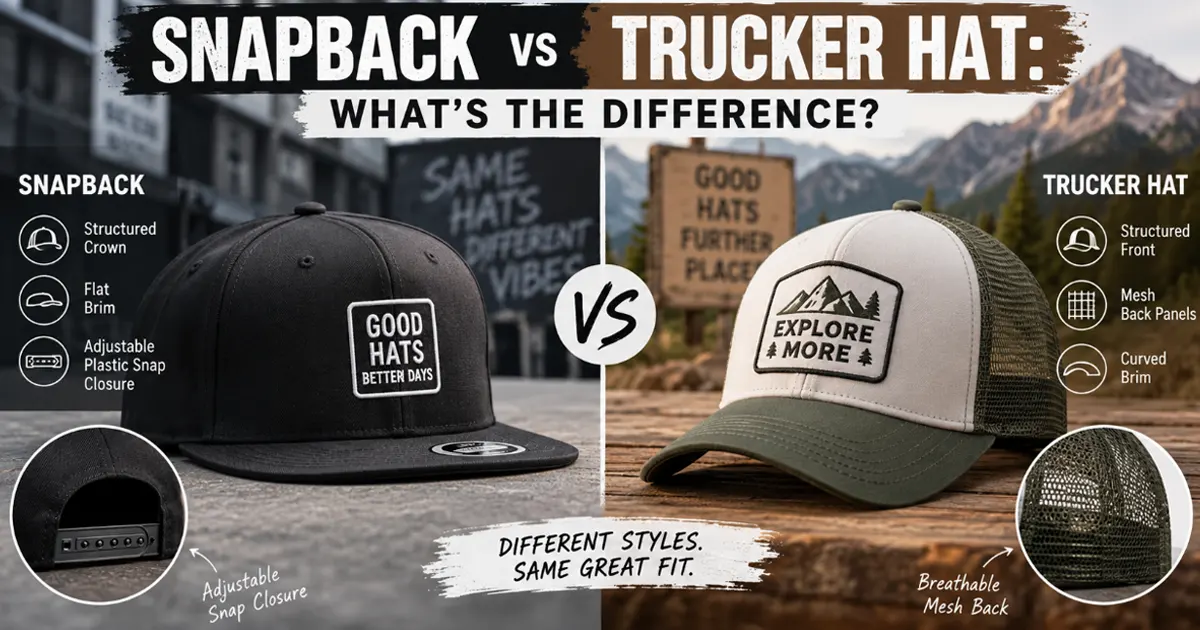
Snapback vs Trucker Hat at a Glance
| Feature | Snapback | Trucker hat |
|---|---|---|
| Defining feature | Plastic snap closure | Solid front with mesh sides and back |
| Rear crown | Solid fabric or mesh | Mostly open mesh |
| Front | Usually woven fabric, often supported | Fabric, foam-backed fabric, or foam |
| Closure | Always plastic snaps | Usually snaps, but other systems exist |
| Profile | Low, mid, or high | Low, mid, or high; taller fronts are common |
| Visor | Flat or curved | Flat or curved |
| Airflow | Depends on crown material | Usually more direct through the mesh |
| Decoration | Front, side, and rear fabric areas may be used | Usually concentrated on the solid front |
What Is a Snapback Hat?
A snapback has two plastic strips at the rear. Studs on one strip press into a row of holes on the other, allowing several circumference settings. The crown can be five-panel or six-panel, soft or firm, shallow or tall, and solid or mesh-backed.
The familiar streetwear snapback often has a high structured crown and flat visor. Those details create the recognizable look, but they are not part of the definition. A low-profile cap with a curved visor is still a snapback if it uses the same plastic closure.
What Is a Trucker Hat?
A trucker hat combines a solid front with mesh side and rear panels. Traditional versions often have a tall foam front, a curved or flat visor, and a plastic snap. Modern truckers may use cotton or polyester twill fronts, lower crown profiles, softer mesh, and performance-oriented fabrics.
The mesh matters more than the closure. It changes airflow, transparency, crown support, and where a logo can be placed. The standalone article on what a trucker hat is explores those variations in more detail.
How Can a Hat Be Both?
Picture a cap with a firm fabric front, mesh back, and plastic snaps. It is a trucker because of the mesh construction and a snapback because of the closure. Remove the mesh and keep the snaps, and it remains a snapback but is no longer a trucker.
Now keep the mesh but replace the closure with a stretch-fit back. The cap is still a trucker, but it is not a snapback. This simple separation prevents the common mistake of treating the two names as opposite styles.
Crown Construction and Shape
Solid-crown snapbacks often use the same fabric around the front, sides, and back. Buckram may sit behind the front panels to keep the crown upright. This creates a continuous, substantial shell and leaves more fabric around the cap for decoration.
Trucker hats split the crown into different materials. A woven or foam front provides the face, while mesh forms most of the remaining crown. Firm mesh helps the back stand away from your head; softer mesh wraps closer and can feel less rigid along the edges.
Either style can have five or six panels. A 5-panel front often avoids a center seam, while a 6-panel front creates a rounder baseball shape. Either can also be low, mid, or high profile. Structure and profile remain separate, as explained in the structured vs unstructured hat guide.
Which One Is More Breathable?
A typical trucker hat allows more direct air movement because open mesh replaces solid rear fabric. On a hot day, you can often feel air reach the back and sides of your head more easily than it does through a full-twill snapback.
Mesh does not make every trucker automatically cooler in every condition. Hole size, mesh stiffness, crown depth, front material, sweatband, lining, color, and activity all affect comfort. A deep foam-front trucker may still feel warm at the forehead, while a lightweight perforated snapback can ventilate well without classic trucker mesh.
Fit and Comfort
If both hats use plastic snaps, their circumference adjusts in the same basic way. The difference you feel usually comes from crown volume and materials. A solid snapback can feel more enclosed and substantial. A trucker exposes more of the head to air, but stiff mesh or a rough edge may feel noticeable if it presses near the ears.
Neither name tells you crown depth. A trucker can sit high and roomy or low and close; the same is true of a snapback. Try the hat at a comfortable closure setting, then check whether the crown reaches the top of your head, whether the front tips forward, and whether the back opening pulls the surrounding panels out of shape.
Adjustment does not make a cap universal. The closure changes the band circumference, but it cannot change the width across your temples or create more room above your head.
Materials
A full-fabric snapback commonly uses cotton twill, polyester twill, canvas, wool blends, nylon, or corduroy. Each creates a different surface and weight. Cotton often feels matte and familiar; canvas has more body; nylon can feel lighter; wool blends bring warmth and a classic sports character.
A trucker uses at least two visibly different zones. The front may be twill, foam-backed fabric, or a simple foam face, while the rear uses mesh. Mesh yarn, hole shape, stiffness, stretch, and recovery affect how it looks and how well the crown returns to shape after being pulled.
Neither style name proves quick drying, water resistance, moisture management, or UV protection. Those claims depend on the selected fabric, finish, construction, and testing. The hat materials guide explains the difference between a fiber name and a verified finished-cap property.
Brim and Profile Differences
Snapbacks are strongly associated with flat brims, and trucker hats with curved brims, but both can use either shape. A flat visor makes the cap look wider and more graphic. A curved visor frames the face and often feels more traditional.
Tall fronts are also common in both categories. A structured snapback uses crown height to create a bold, upright silhouette. A foam-front trucker may be just as tall, although the sloping mesh back gives it a different side view. Lower versions of both styles are available for people who prefer less space above the head.
Logo and Decoration Options
A solid snapback offers fabric at the front, sides, and rear, although seams and the back opening still restrict placement. Structured fronts support embroidery well, and five-panel fronts can provide a continuous area for a patch or print.
Trucker decoration is usually concentrated on the solid front. Open mesh gives needles, inks, and transfers less support, so side and rear branding may need a label or another method designed for that area. Foam fronts work well with bold graphics, but dense stitching or high pressure can dent the surface.
The logo method should follow the exact cap. Flat embroidery handles many detailed shapes, 3D puff favors bold forms, woven patches preserve fine lines, and printing suits smooth compatible surfaces. A technique that looks clean on firm twill may behave differently on foam or a curved soft front.
Which Should You Choose?
| Your priority | Better starting point | Reason |
|---|---|---|
| Classic solid streetwear crown | Snapback | Full fabric and a firm front create a substantial shape |
| More direct airflow | Trucker hat | Mesh opens the side and rear crown |
| Side or rear embroidery | Solid-crown snapback | More conventional fabric areas are available |
| Bold front patch or print | Either | Front-panel shape and support matter more than the category name |
| Traditional foam-front look | Trucker hat | Foam and mesh create the recognizable vintage silhouette |
| Adjustable fit | Either with snaps | Many truckers use the same closure as a snapback |
If heat and ventilation lead your decision, start with the trucker. If you want a continuous solid crown or more fabric decoration areas, start with the snapback. When the visual front matters most, compare profile, panel layout, visor, and support before worrying about the label.
For another boundary that often causes confusion, see trucker hat vs baseball cap.
How Weather Changes the Choice
In dry heat, open mesh can make a trucker hat feel noticeably airier across the sides and back. The front still matters: a thick foam face and heavy sweatband may hold more warmth against the forehead than a light woven front.
In cool or windy weather, a solid-crown snapback offers more coverage. Mesh does not block moving air in the same way, which can be welcome in summer and less comfortable on a cold day. Neither style replaces a wide-brim sun hat or insulated winter cap when those functions are the real priority.
Humidity adds another variable. Airflow helps evaporation only when moisture can move away from the skin and surrounding air can accept it. Sweatband material, crown fit, fabric finish, and decoration coverage all contribute. A large impermeable transfer can create a warm spot even on an otherwise open cap.
Light rain does not automatically favor either style. Mesh lets water pass through, while solid fabric may slow light moisture but is not necessarily water-resistant. A stated water-repellent or waterproof property requires a specific material, construction, and level of protection.
Fit Problems: Snapback vs Trucker
| What you notice | More common source | What to check |
|---|---|---|
| Pressure at the temples | Crown width or tight closure on either style | Try a broader crown rather than only opening the snap |
| Scratchy feeling near the ears | Stiff mesh edge or seam on a trucker | Compare softer mesh and cleaner edge finishing |
| Cap feels enclosed | Dense solid fabric or lining on a snapback | Look for lighter fabric, vents, or mesh panels |
| Rear panels pull unevenly | Closure near the end of its range | Check the base size and rear opening shape |
| Front tips forward | Crown is too deep or foam front is very upright | Try a lower profile or different front angle |
| Empty space above the head | High profile or rigid crown | Compare a mid- or low-profile version |
The snap closure can be identical on both hats, so a fit difference should not automatically be blamed on the hardware. Mesh stiffness, panel depth, front support, and crown width often explain more.
Mesh Types and Front Materials
Traditional trucker mesh is often firm enough to hold a rounded rear crown. Softer mesh drapes closer to the head, while stretch mesh can move with the wearer. Hole size changes both visibility and hand: larger openings look more transparent, while smaller openings create a denser surface.
The front can be a simple foam face, foam laminated to fabric, supported twill, or an unstructured woven panel. Foam produces a broad surface and a recognizable vintage look. Twill feels more like a conventional baseball cap, while lightweight woven fabric can move the style toward running, golf, or outdoor use.
On a solid snapback, material remains more consistent around the crown. That can make the cap feel visually unified and creates more familiar side-logo areas. It can also make the hat heavier or less ventilated if the fabric is dense and the front has multiple layers.
Mesh quality cannot be judged only by how open it looks. Recovery after stretching, seam behavior, edge softness, snag resistance, and color consistency all affect the wearing experience and appearance over time.
Wearing Either Hat Backward
When worn backward, the closure moves to the forehead. On a snapback, the plastic tabs become the main contact point, so a thick or sharply curved closure may feel more noticeable. The visor also rests against the back of the neck differently depending on its length and curve.
A trucker worn backward places the rear opening and surrounding mesh at the front. This can feel lighter, but stiff mesh seams may sit closer to the temples. Hair can pass through the opening on either style, although the opening shape and crown depth decide whether the cap stays balanced.
The better backward fit is therefore personal. Try the cap in both orientations rather than assuming an adjustable closure guarantees equal comfort.
Durability and Care Differences
Solid woven panels usually tolerate light surface brushing better than open mesh, which can catch on hooks, rough storage surfaces, or aggressive cleaning tools. Foam fronts can dent when compressed, and heat may affect laminated layers or adhesives.
Check the care label before cleaning. Spot cleaning is often a cautious starting point for structured snapbacks and foam-front truckers. If the cap becomes wet, reshape the crown and visor, then air-dry it without placing weight on the front.
Do not pull the mesh to wring out water. Stretching can change the rear shape or place extra tension on the seam where mesh meets the front. On a solid snapback, avoid drying the crown folded, especially when buckram is damp and more likely to set into a crease.
Frequently Asked Questions
Is a trucker hat a snapback?
Many are. A trucker is also a snapback when it uses a plastic snap closure.
Is every snapback a trucker hat?
No. A full-fabric cap with plastic snaps is a snapback but does not have the mesh construction that defines a trucker.
Which is more breathable?
A typical mesh-back trucker allows more direct airflow. Actual comfort still depends on mesh openness, front material, sweatband, fit, weather, and activity.
Which is better for embroidery?
A solid structured snapback provides more conventional embroidery zones. A trucker can also embroider well on a suitable front, but the mesh limits many side and rear applications.
Do both styles have flat brims?
They can, but neither style requires one. Flat, lightly curved, and pre-curved visors appear on both.
Are trucker hats always foam-front hats?
No. Foam-front versions are traditional, while many modern truckers use woven cotton, polyester, nylon, or other fabric fronts.
Conclusion
Choose a snapback for the closure and a trucker for the mesh-back construction—then remember that one cap can offer both. HENGXING can develop the crown, mesh, profile, visor, and decoration together as custom trucker hats.