
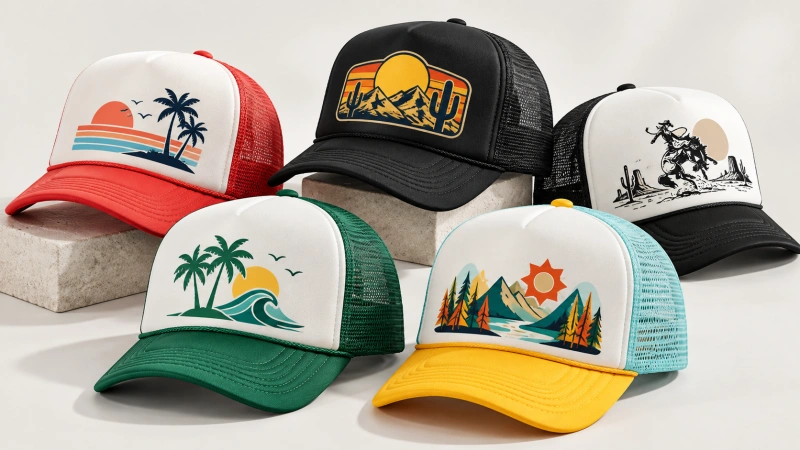
Custom Foam Trucker Hats for Bulk Orders
A foam trucker hat pairs a padded front with a mesh back for a recognizable silhouette and a broad surface for artwork. If you are developing custom foam trucker hats for a brand, event, or merchandise program, the front construction, crown shape, and decoration need to work together. HENGXING can review your reference style and project requirements, then confirm feasible materials and production details for the selected design.
Define your foam trucker hat requirements by specifying quantity, front foam construction, mesh type, colors, closure, logo artwork, decoration method, and delivery destination. For other front materials and a broader range of structures, explore our custom trucker hats. Send your project details to HENGXING for feasibility review, sampling options, and a quotation.
Foam Trucker Hat Styles
Choose the foam-front surface and finished panel feel first. Panel count, crown height, rope detail, and brim shape are separate design decisions. The foam-front constructions below provide useful starting points for custom development. Available materials, combinations, and production details should be confirmed for your selected style and order.
| Foam Front Option | Typical Construction | What to Check in Sampling |
|---|---|---|
| Polyester-faced foam | Polyester fabric over a foam front, commonly paired with a mesh back. | Check surface smoothness, panel recovery after light compression, and the finished logo appearance. |
| Cotton-faced foam | Cotton-faced foam front with a mesh back and a matching or contrasting brim. | Compare hand feel, surface wrinkling, and the result of your selected print or embroidery. |
| Cotton-twill-covered foam | A foam front covered with cotton twill for a more textile-focused surface. | Confirm the layer construction, bonding, surface finish, and appearance after normal handling. |
The three constructions above illustrate common foam-front directions that can be considered during custom development. Actual material combinations, panel construction, colors, and decoration compatibility should be confirmed for the selected style before sampling and bulk production. If you already have a reference cap, send clear front, side, back, and inside photos together with your target quantity, colors, and logo artwork. If you are starting from artwork, specify the preferred front area, crown shape, brim style, and overall fit so HENGXING can review feasibility and prepare an appropriate sample direction.
What Makes a Foam Front Trucker Hat Different?
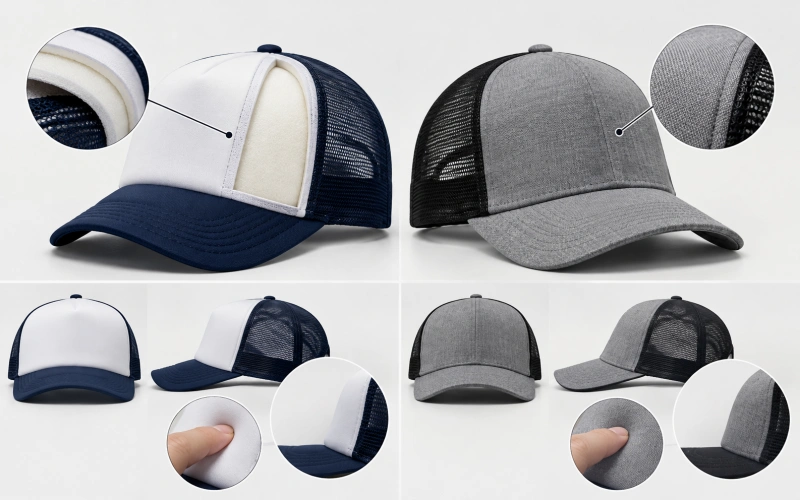
The key difference is the front-panel construction. A foam trucker hat typically uses foam beneath or together with the visible front fabric, while the rear panels are usually mesh. This creates a fuller, more padded front and can affect how the cap responds to embroidery, printing, heat, compression, and packing. A fabric-front trucker hat may look similar in photos but can differ noticeably in hand feel, structure, and shape retention.
When comparing options, confirm how the front panel is built, which material covers the foam, and how firm the finished panel feels. Review the cap from both the front and side, and evaluate the actual sample rather than relying on descriptions such as “thick foam” or “high-density foam” without a defined specification. If you are considering different front constructions, compare them with our broader custom trucker hats range before finalizing the foam-front design.
Foam Front and Mesh Specifications
Specify the foam front as a complete assembly, including the face material, foam layer, and any backing or bonding used in the construction. Depending on the selected style, the visible surface may use polyester, cotton, cotton twill, or another suitable fabric. Confirm the actual layer construction, foam thickness or density, and the measurement method used for the selected sample.
| Foam-Front Item | Specification to Confirm | What to Check During Approval |
|---|---|---|
| Visible surface | Face material, composition, texture, and color | Does the surface stay smooth, and does the planned logo reproduce clearly on the selected fabric? |
| Foam and bonding | Foam thickness or density, layer structure, backing, and bonding method | Does the panel recover after light compression without visible separation, wrinkling, or lasting dents? |
| Foam-to-mesh transition | Rear mesh material, firmness, color, and seam construction | Does the mesh support the approved crown profile without pulling, distortion, or wrinkling at the seam? |
For a two-tone cap, compare the foam front and mesh under the same lighting to check color coordination. If artwork sits close to the edge of the foam panel, review its placement on the physical crown rather than relying only on a flat mockup. For broader fabric options, see the hat materials guide.
Send a reference image or approved color standard when a specific visual match is important. Final material, color, foam, and mesh combinations should be confirmed for the selected style and order through sampling before bulk production.
Choose the Crown, Brim and Closure
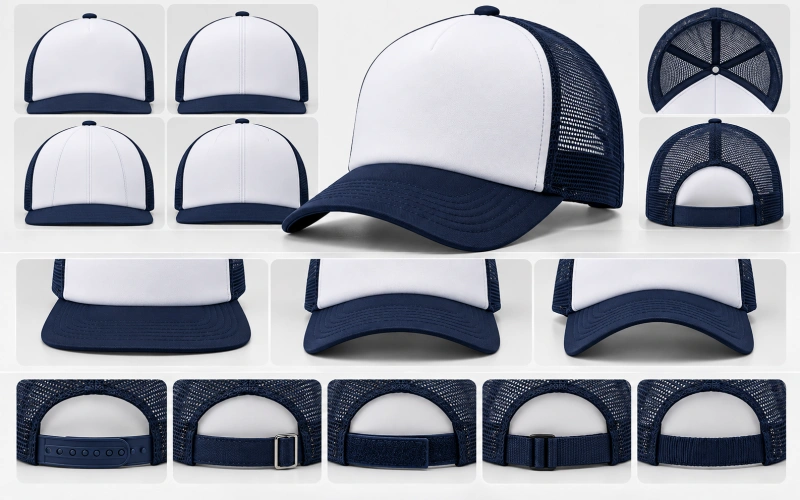
Record the panel count, crown height, brim shape, and closure type from your reference cap, because each affects the finished foam-front silhouette. A front seam can interrupt a large graphic, while crown depth changes how the padded front curves on the wearer. Confirm the front-panel height and usable decoration area on the selected physical sample rather than treating “foam” as a fixed cap shape.
Brim shape and rear adjustment can also change how the same front panel looks and fits. Include both in the sample brief, then check whether shaping the brim or adjusting the closure causes pulling, wrinkling, or compression across the foam front.
Decoration Options for Foam Trucker Hats
Record the panel count, crown height, brim shape, and closure type from your reference cap, because each affects the finished foam-front silhouette. A front seam can interrupt a large graphic, while crown depth changes how the padded front curves on the wearer. Confirm the front-panel height and usable decoration area on the selected physical sample rather than treating “foam” as a fixed cap shape.
Brim shape and rear adjustment can also change how the same front panel looks and fits. Include both in the sample brief, then check whether shaping the brim or adjusting the closure causes pulling, wrinkling, or compression across the foam front.
| Decoration Method | What to Review on the Foam Front | Sample Approval Check |
|---|---|---|
| Print or transfer | Edge clarity, color reproduction, surface feel, and the effect of heat or pressure | Check the finished graphic for clean edges, consistent color, and visible panel distortion |
| Flat embroidery | Stitch density, backing, puckering, and changes to the padded front | Review the actual-size artwork on the selected foam front for shape and stitch quality |
| Patch | Patch size, edge shape, attachment method, curved-panel fit, and added weight | Check attachment, alignment, and how the panel holds its shape after handling |
A graphic that looks balanced on a flat digital mockup may appear different once applied to a curved, padded front. Approve the decoration on the proposed foam-front construction and evaluate the complete cap after normal handling.
For additional embroidery, patch, printing, and trim options across different hat styles, see our customization options.
Select a Foam Trucker Hat for Your Program
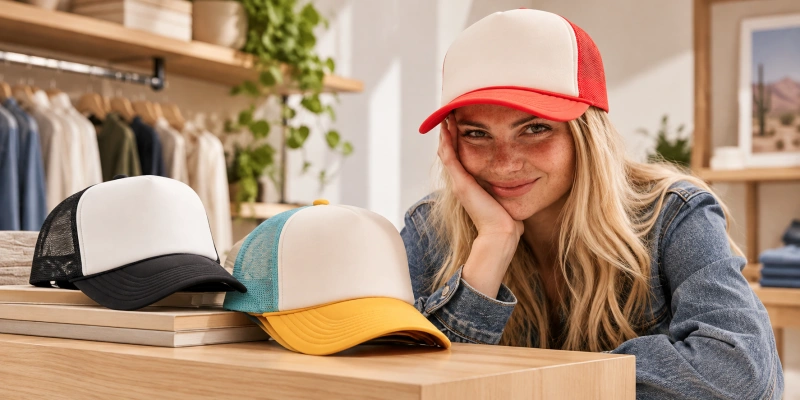
For a retail line, review the padded front on a wearer and after normal handling, not only in a flat product photo. If several colorways are planned, approve the artwork on each front color and check how the foam front, mesh back, brim, and decoration work together. If the hats will be stacked or packed for distribution, inspect a packed sample for lasting dents, creases, or surface wrinkles.
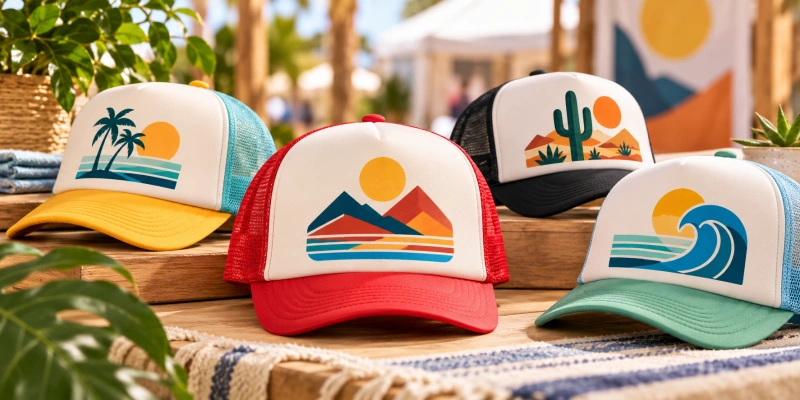
For an event or promotional program, test the actual logo size on the curved foam front and review its visibility from a normal viewing distance. For a team or uniform order, compare the proposed cap color and decoration with your approved brand, garment, or uniform reference. These checks help confirm how the foam-front construction performs in the intended application.
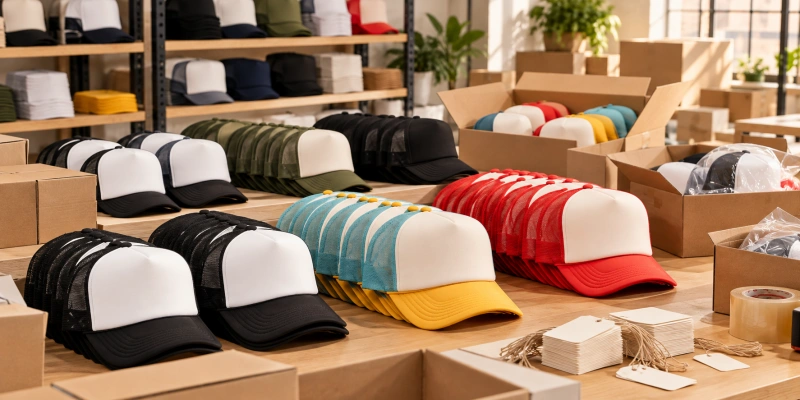
For wholesale and bulk foam trucker hat projects, send the estimated quantity by color and design, target delivery date, destination, labeling requirements, and packaging needs. MOQ, sampling time, and production schedule depend on the confirmed construction, decoration, and order details, so HENGXING will confirm these requirements for the specific project rather than applying specifications from another style.
MOQ, Lead Time and Quote Inputs
A useful quotation starts with a clear product specification. Send your target quantity per design and color, destination country, required delivery date, and intended application. Include a reference style or photos, preferred panel layout and crown profile, foam-front and mesh color direction, visor and closure preferences, logo artwork, decoration position, labels, and packaging requirements. Also indicate whether you need a sample before bulk production approval.
MOQ, sampling time, pricing, and production lead time depend on the confirmed foam-front construction, materials, decoration, colorways, and order quantity. Different colors, trims, logo methods, or packaging requirements can affect the production route, so these terms should be confirmed for the specific project rather than estimated from another hat style or stock program.
For a newly developed foam trucker hat order, request a project-specific MOQ by design and color, sample cost and schedule, quotation basis, estimated bulk production time, freight terms, and delivery terms. The quotation should identify the confirmed specifications and any assumptions that may change after sample development and approval.
Custom Foam Trucker Hat Order Process
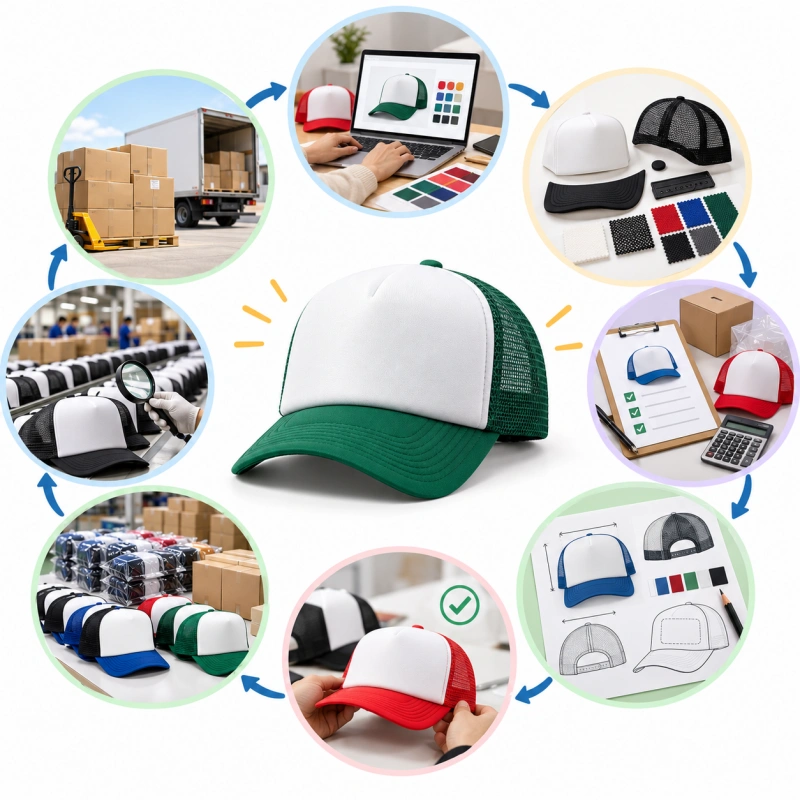
Follow these steps to move from an initial requirement to an approved bulk order:
- Submit your inquiry. Send the expected quantity by color and design, destination, target date, reference style, logo artwork, and packaging requirements.
- Review product feasibility. Confirm the proposed foam-front construction, mesh, colors, decoration methods, closure, and other components that can be developed for the project.
- Review the quotation. Confirm the quotation basis, project-specific MOQ, sampling requirements, estimated schedule, and applicable commercial terms.
- Confirm the sample specification. Agree on the artwork, proposed materials and colors, key measurements, decoration placement, and other details required for sample development.
- Develop and approve the sample. Review the finished decorated sample for shape, fit, materials, colors, logo appearance, and construction. Record any required revisions before approval.
- Confirm the bulk order. Finalize quantities by color and design, approved specifications, artwork, labels, packaging, and agreed delivery requirements.
- Run bulk production and quality checks. Produce the order to the approved specification and inspect the relevant materials, construction, decoration, and finished goods.
- Pack and ship the order. Complete the agreed packing, final checks, and shipment arrangements before dispatch.
If sample revisions change the materials, construction, colors, decoration, or other important specifications, confirm any effect on pricing and schedule before bulk production begins. This keeps the approved product specification aligned with the commercial order.
Sample Development and Approval
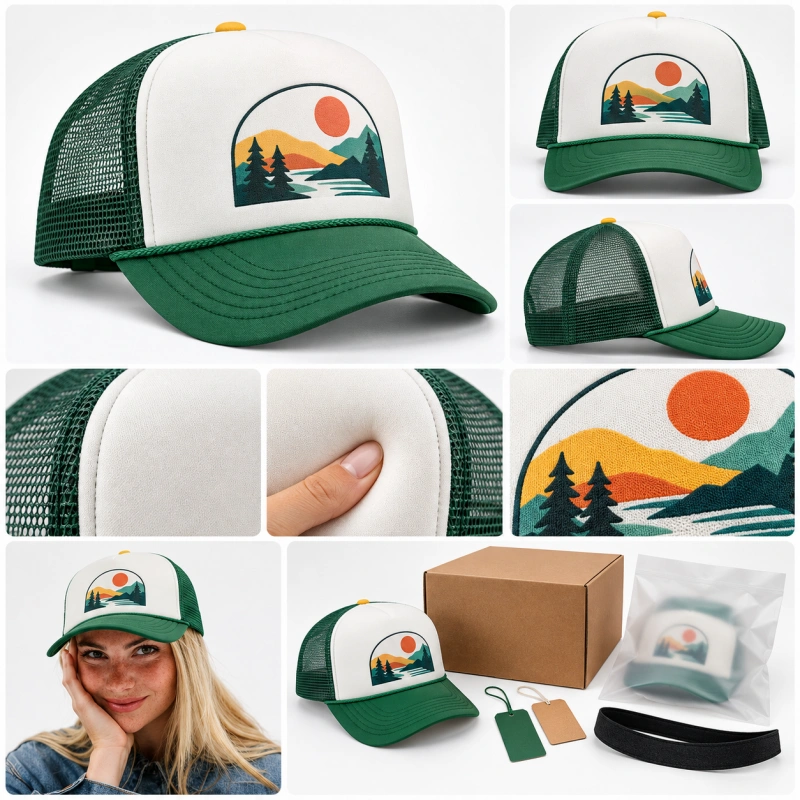
After the product direction, quotation, sampling requirements, and sample schedule are confirmed, develop a finished decorated sample for approval before bulk production. Start by reviewing the front height and symmetry from both the front and side. Check for dents, creases, uneven compression, surface wrinkling, and distortion around the seams. Feel the firmness of the foam panel and confirm that the crown curve and overall shape match the agreed reference.
- Compare the foam front and mesh together, including mesh opening, firmness, recovery, and color balance.
- Check crown depth, circumference, visor dimensions, closure adjustment, and fit on representative wearers.
- Review logo size, placement, edge quality, and the finished embroidery, print, transfer, or patch result on the foam front.
- Inspect the sweatband, interior taping, labels, trims, and proposed packaging.
- Record the approved materials, color references, artwork version, key measurements, sample photographs, and agreed tolerances where applicable.
Record the approval or requested revisions in writing. If the sample changes, confirm whether the revision affects pricing, MOQ, materials, or lead time before bulk production is confirmed. A digital mockup is useful for reviewing the design direction, but the physical sample is needed to evaluate foam firmness, mesh feel, fit, and whether the decoration changes the shape of the padded front.
Bulk Production Quality Checks
Use the approved sample and final specification as the reference for bulk production. During material and component checks, confirm the specified foam-front construction, face material, mesh, colors, and trims. During cutting, decoration, and sewing, review front-panel symmetry, foam condition, logo placement, stitching quality, and any visible puckering or distortion.
After assembly and shaping, compare the finished caps with the approved sample for crown profile, front-panel shape, visor curve, closure function, and overall appearance. Foam fronts should also be checked for unwanted compression, dents, wrinkles, or shape changes caused during production and handling.
At final inspection, review color consistency, decoration quality, loose threads, cleanliness, construction, and packaging. Packing should protect the foam front from excessive pressure that could deform the crown during storage or transport. Inspection requirements and applicable tolerances should be confirmed for the selected style before bulk production.
For HENGXING’s broader quality approach, see our quality and compliance information. Foam-front inspection points should be finalized against the approved sample and project specification.
Foam Trucker Hat FAQs
Are Foam Trucker Hats Always Five Panel?
No. Five-panel foam trucker hats are common, but panel count depends on the selected construction. Confirm the panel layout, crown profile, and front seam when developing your style.
Can You Print or Embroider on a Foam Front?
Yes, depending on the face material, foam construction, artwork, and decoration method. Approve the intended print, embroidery, transfer, or patch on a physical sample before bulk production.
What Is the MOQ for Custom Foam Trucker Hats?
MOQ depends on the construction, materials, colors, decoration, and quantity required for each design. Send your estimated quantity by color and design so HENGXING can confirm the applicable MOQ with the quotation.
Can I Approve a Sample Before Bulk Production?
Yes. A physical decorated sample can be used to confirm the cap construction, fit, colors, decoration, and other agreed specifications before bulk production.
How Should Foam Trucker Hats Be Packed?
Packaging should protect the padded front from excessive compression during storage and transportation. Confirm the individual packing, carton arrangement, and any retail packaging requirements for the specific order.

Request a Foam Trucker Hat Quote
Send your reference cap or design, estimated quantity by color, intended market, foam-front and mesh preferences, logo artwork, target delivery date, and destination. If your project requires custom labels, hang tags, or special packaging, include those requirements in the same inquiry. HENGXING can then review the proposed construction and confirm suitable options, sampling requirements, and a project-specific quotation.