
If you want to wash a baseball cap without ruining its shape, first read its care label and check the brim, crown support, sweatband, and decoration. When you cannot confirm that the complete cap is machine washable, gentle spot cleaning or a controlled hand wash is a sensible starting point.
Use a compatible mild cleaner, test a hidden area, avoid twisting the brim, and let the cap air dry with its shape supported. An old cap with a moisture-sensitive brim or a delicate patch may need spot cleaning only. The safest method depends on the finished cap, not just the fabric named on its label.
Before You Wash: Check the Entire Cap
You can usually see the outer fabric, but the parts most vulnerable to water may be hidden. A brim insert, front-panel reinforcement, embroidery backing, adhesive, or coated trim can react differently from the shell. The care label takes priority if it gives usable instructions. If the label is missing, avoid assuming that a soft crown or a cotton shell makes the whole cap washable.
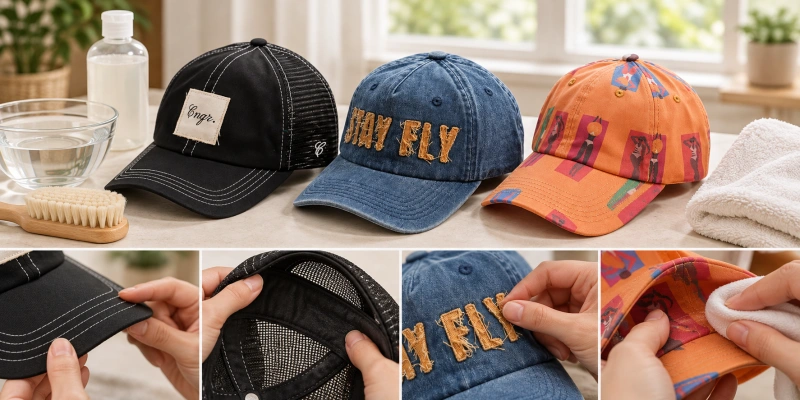
Use this quick inspection before choosing a cleaning method:
| Check | What to Look For | What It Means for Cleaning |
| Care label | Washing symbols, temperature, drying and professional-care instructions | Follow the instructions for this finished product; ask the seller when they are unclear. |
| Brim and crown | Insert material, stiffness, foam, buckram and glued support | Unknown or moisture-sensitive parts favor targeted cleaning over immersion. |
| Shell and sweatband | Fiber, finish, dark dye, soil and salt marks | Different pieces may release dye or change shape at different rates. |
| Branding and trims | Raised embroidery, patches, prints, labels, leather and hardware | Protect edges, adhesives and finishes from rubbing, heat and long wet contact. |
| Age and condition | Vintage construction, cracked coating, loose stitching or a bent brim | Fragile or already damaged caps may need a specialist rather than a full wash. |
Look at the underside of the brim and the inside front panel. If you suspect a cardboard insert, do not soak the brim. You cannot reliably identify every insert by touch or age alone, so uncertainty is a reason to keep water localized. Structured vs unstructured hats explains the crown difference, but either type can include other components that limit cleaning.
Before adding cleaner to a visible area, dampen an inconspicuous spot with the proposed diluted solution. Blot with a light-colored cloth and check for color transfer, staining, finish change, or lifting at patch edges. Let that spot dry before deciding whether to continue. A successful spot check reduces one risk; it does not prove that the brim insert, backing, or whole cap tolerates soaking.
The Best Way to Wash a Baseball Cap by Hand
For an ordinary washable cap with no warning on its label, hand washing gives you control over water, contact time, and pressure. It is still possible to damage a cap by soaking it too long or scrubbing a sensitive component. Work gently and keep the brim supported rather than folding or wringing it.
1. Remove Loose Dirt
Shake out loose debris. Use a clean, soft brush or dry cloth on surface dust, especially along seams and the sweatband. Brush in the direction of the fabric’s surface where it has a nap. Do not drag a stiff brush across embroidery loops, raised lettering, or patch edges. Cleaning dry debris first keeps it from spreading when you add water.
2. Prepare Water and Test the Cleaner
Use a clean basin with cool water and a small amount of mild detergent that suits the cap’s labeled materials. Mix the solution before it touches the fabric so concentrated cleaner does not land on one spot. Test it on an inconspicuous area as described above. If the label specifies another method, follow that instruction. Avoid bleach, strong stain removers, and improvised chemical mixtures unless the finished cap’s care information permits them.
3. Treat the Dirtiest Areas First
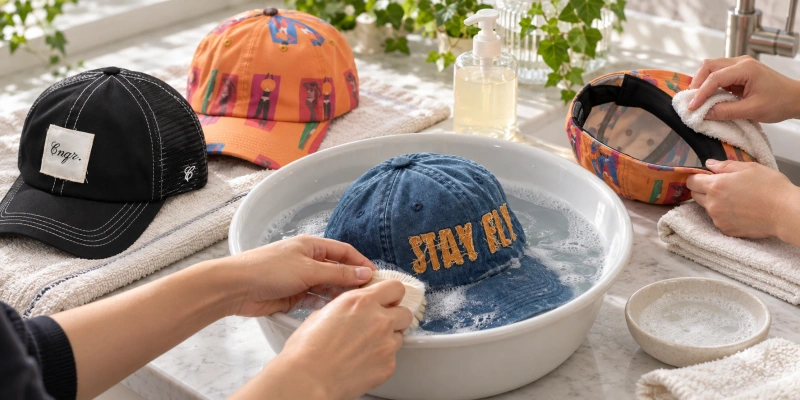
Dip a soft cloth in the diluted solution and gently blot the sweatband, inner seam, and localized marks. Work from the outside of a mark toward its center to avoid spreading it. For sturdy, unadorned fabric, a soft brush can help, but use very light pressure. Keep wet cleaning away from questionable brim inserts, leather patches, and adhesive details. If a stain does not lift, do not escalate immediately to hard rubbing.
4. Wash Only as Much as the Cap Allows
If the care label and construction support immersion, lower the fabric sections into the water and move the cap gently through the solution. Support the crown and brim with your hands. A short, controlled wash is more useful than leaving the cap submerged while you do something else.
If you cannot verify the insert or trim, clean the shell and sweatband in sections with a damp cloth instead of dipping the entire cap. Do not twist the crown, bend the brim, or pull at the closure.
5. Remove Cleaner Thoroughly
For an immersion-safe cap, rinse gently with cool, clean water until detergent is removed. For a cap cleaned in sections, use a separate damp cloth to lift remaining cleaner, then blot with a dry towel. Rinse conservatively around bonded patches or printed areas; prolonged saturation can affect adhesives and finishes. Residual cleaner can leave a visible ring or a stiff feel, so take time to remove it without flooding a sensitive part.
6. Blot, Support and Air Dry
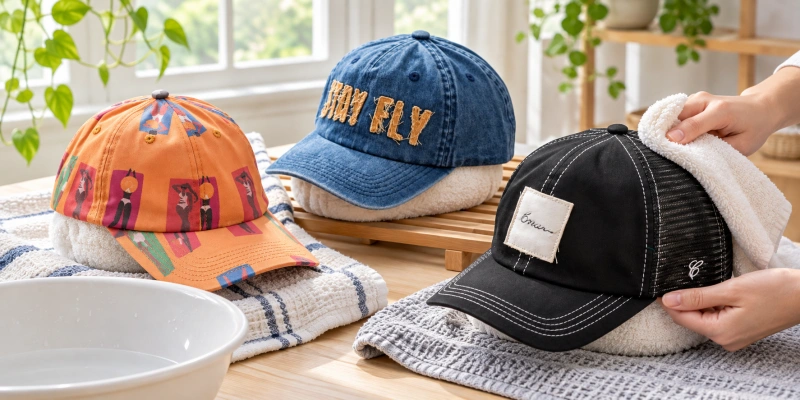
Press a clean towel against the cap to take up water. Do not wring it. Bring the crown back to its intended form by hand and support it with a clean, suitably shaped object or loosely placed colorfast towel that will not transfer dye. Leave the brim in its intended position without forcing a new curve. Air dry in a ventilated place away from direct heat, then check the sweatband and inner front panel before storage. Detailed drying guidance appears below.
The best way to wash a baseball cap is the least forceful method that removes the soil while respecting its approved care instructions. You do not need to immerse the entire cap to clean a sweatband mark. Conversely, a cap approved for a full wash may need a complete rinse to remove detergent evenly.
Can You Wash a Baseball Cap in the Washing Machine?
Sometimes, but only when the cap’s care instructions and complete construction permit machine washing. A gentle cycle does not make every cap safe: tumbling, pressure from other garments, spin action, and sustained wetting can distort a brim or supported front. An unstructured crown alone is not proof of machine washability; a structured cap is not automatically prohibited if its maker has approved a particular method.
If machine washing is explicitly allowed, use the temperature and cycle on the care label. Keep the cap from being crushed by bulky laundry; a suitable protective bag may reduce snagging but cannot protect a moisture-sensitive insert or adhesive.
Remove the cap promptly and support its intended form while it air-dries, unless its label provides different drying instructions. If there is no machine-wash approval or you cannot identify the brim and trims, choose controlled hand or spot cleaning instead.
For a brand developing a new cap, “machine washable” is a performance requirement for the finished decorated product, not a property you can infer from a fabric swatch. The brim, support, sweatband, thread, patches, and labels need to be considered together before care wording is approved.
Can You Wash a Baseball Cap in the Dishwasher?
Do not treat the dishwasher as the default way to clean a cap. Dishwashers are designed for dishes; water jets, detergent chemistry, temperature, and drying heat may be unsuitable for fabric, dyes, brim inserts, and adhesives. A cap frame may help maintain a silhouette, but it does not make an incompatible material or decoration safe. Advice online differs because caps and machines differ.
Only consider a dishwasher if the cap maker specifically approves that process for the finished cap and you can follow its exact instructions. In the usual case where no such instruction exists, hand or targeted cleaning gives you better control. Do not substitute dishwashing tablets for a cap-compatible cleaner. If you have a valuable vintage or collector cap, avoid experimenting with dishwasher cleaning.
What If Your Baseball Cap Has Sweat Stains?
Start with the sweatband and stained area rather than soaking the entire cap. Blot a fresh mark with a clean, damp cloth. For a set-in mark, check the finished cap’s care instructions and test a compatible mild cleaner on a hidden area.
Work gently, lift residue with a second damp cloth, and let the sweatband dry fully before reassessing. Avoid hard scrubbing or untested bleach and baking-soda mixtures, especially around dark dyes, patches, adhesives, or a moisture-sensitive brim.
For the complete method covering older marks, salt rings, yellowing, and sweatband buildup, see how to remove sweat stains from baseball caps.
How to Dry a Baseball Cap Without Losing Its Shape?
After cleaning, blot the cap with a towel; do not wring the brim or squeeze a reinforced front panel flat. Gently return the crown to its normal form while the fabric is damp, then place it over a clean support that fits without stretching it. Keep the brim unobstructed and let air circulate the sweatband and inner panels. Avoid a hot dryer, radiator, or concentrated heat unless the care label specifically permits the method.
Check the inside before putting the cap away. The outside can feel dry while the sweatband or supported front remains damp. If the cap was already crushed, collapsed, or bent before washing, basic drying support may not repair it. That is a separate restoration task; do not try to force the brim or front panel into a new shape during a routine wash.
How Material and Construction Change the Cleaning Method?
Fiber content helps you identify a possible risk, but it does not settle the wash instruction. Use this comparison to decide what to inspect, then check the approved finished cap. For a broader explanation of fabric choices and finishes, see the hat materials guide.
| Material or Feature | Main Cleaning Consideration | Practical Starting Point |
| Cotton or Cotton Blend | Dye, shrinkage, finish, and the non-cotton parts may respond differently. | Follow the label; test color and clean gently before any full wet wash. |
| Polyester or Nylon | Fabric may tolerate water, while coatings, prints, adhesives or support may not tolerate heat or agitation. | Check trims and temperature instructions; do not infer machine safety from fiber alone. |
| Wool or Wool Blend | Agitation, heat and water can affect hand, size and appearance. | Follow the stated care route; use localized cleaning or specialist advice when uncertain. |
| Leather, Suede or Special Trim | Water and ordinary laundry cleaner can mark or stiffen a trim. | Keep cleaning localized and use trim-specific instructions or professional care. |
| Foam or Reinforced Front | Compression, saturation and heat can change the crown silhouette. | Avoid crushing; confirm how the complete cap may be wetted and dried. |
The brim insert is particularly important because you usually cannot see it. A washable polyester shell with a vulnerable insert still needs a conservative wash route. Likewise, a soft cotton crown may carry a heat-transfer logo or leather patch with its own limits. If you are selecting materials for a brand program, discuss the desired care route while those components are still being specified, not after the care label has been printed.
How to Clean Embroidered, Patched and Custom Branded Caps
Brand decoration changes where you can put pressure and how much water or heat the cap should see. Flat embroidery has stitches and backing; raised embroidery projects farther from the panel and can catch on a brush or another garment. Dab around the design and avoid rubbing across stitch loops. If you see loose threads, do not pull them. For construction and placement options, see embroidered baseball caps.
A sewn patch may have edges that catch; a bonded patch or heat-transfer print may also depend on adhesives that react to heat or extended wet contact. Leather and faux-leather details can have different care requirements from the shell. Metal closures, eyelets, and branded hardware may retain moisture at attachment points.
Wipe these areas separately and dry them thoroughly. If you cannot identify how a patch is attached, avoid soaking it as an experiment.
Pay attention to the inside as well. A branded sweatband, printed care label, woven tape, or heat-applied size mark can be damaged even if the external logo looks fine. A cap with several decoration methods should follow the most restrictive applicable care instruction. For a brand owner, a good-looking blank-cap trial is not enough to establish the care route for the decorated version.
What Brands Should Specify About Care Before Bulk Production?
If you are ordering custom caps, tell your supplier how the wearer is expected to clean them. Do you need only spot cleaning, a controlled hand wash, or a product that can carry a verified machine-wash instruction? State that requirement alongside the fabric, brim, front support, sweatband, logo method, patch attachment, closure, and care-label wording. Ask how the proposed materials and decoration affect the care instruction for the finished cap.
Review the decorated sample as the reference product. If you intend to make a washability claim, agree in advance on the method, acceptance criteria, and evidence needed to support it; do not assume that a factory performs a particular wash test.
A change to fabric, coating, brim insert, backing, or logo application can change the care route, so revisit the instruction when an approved component changes. This keeps the label aligned with the actual product buyers will receive.
HENGXING’s custom baseball caps page describes material, construction, decoration, sample and label choices. Use those decisions to raise the care question early in development. A practical brief can say: “Please confirm the intended cleaning method for the approved finished cap and flag any component that limits it.” That is clearer than asking whether a fabric is “washable” in isolation.
FAQs
Can You Wash Every Baseball Cap by Hand?
No. Hand washing offers more control than a machine, but some vintage inserts, wool constructions, leather details, bonded patches, or damaged finishes may not tolerate immersion. Follow the finished product’s care instructions. If those are unavailable, spot test and limit moisture; consider specialist advice for valuable or fragile caps.
Can You Put a Baseball Cap in the Dryer?
Only if its care label expressly permits the relevant heat and setting. Otherwise, blot the cap, support its shape, and let it air dry. Dryer heat and tumbling can affect materials and details differently, so a cap that survived washing is not necessarily suitable for tumble drying.
How Do You Clean a White Baseball Cap With Yellow Stains?
Check the finished cap’s care label, brim insert, sweatband, and colored logo before wet cleaning. Test a compatible mild cleaner on a hidden area and let the test spot dry. Gently treat the yellow mark, lift away cleaner with a separate damp cloth, and air dry the cap in its intended shape.
Body oils, transferred dyes, or aged materials may leave discoloration that cannot be fully removed. Do not assume a white shell makes the entire cap bleach-safe.
For the white-fabric method and the risks around embroidery, patches, and yellowing, see how to clean a white baseball cap.
What if the Brim Contains Cardboard?
Avoid soaking it. Clean the shell and sweatband in controlled sections without saturating the brim, then blot and air dry. If you do not know what the insert is made from, treat the brim as moisture-sensitive rather than guessing from the cap’s age or sound.
Can You Dry Clean a Baseball Cap?
Follow the care label. Some materials or trims may call for professional care, but dry cleaning is not automatically suitable for every cap or adhesive. Explain the brim, logo, and trim construction to the cleaner and ask whether they can handle the particular finished product.
How Often Should You Wash a Baseball Cap?
Clean when soil, sweat, or odor warrants it, while following the label and using the least disruptive effective method. Spot cleaning the sweatband may be sufficient between fuller cleanings. There is no universal washing interval for every cap: wear conditions, material, finish, and decoration vary.
Clean the Cap You Have, Not the Fabric Name Alone
To wash a baseball cap without sacrificing its shape, inspect the complete construction, follow the care label, test a hidden area, and use gentle handling. Choose machine or dishwasher cleaning only when the finished cap’s instructions support it.
For branded production, settle the intended care route while you are choosing components and approving the decorated sample. If you are developing custom baseball caps, share your care expectations with HENGXING alongside your material, structure, and decoration brief.