
Many modern golf caps use the same crown and front visor construction as baseball caps. The real differences often lie in how you intend to use the cap and which fabric, sweatband, ventilation, fit, and branding details you specify. A baseball-style cap can therefore be a golf cap when it is designed or selected for play. Before you choose a label for your order, compare the finished specifications and sample against your wearers’ needs.
If you are buying for a golf club, tournament, team, or retail collection, the question is less about which name sounds right and more about what your audience will wear comfortably. A familiar cotton cap might suit a pro shop. A lighter build with a suitable sweatband may serve an outdoor event better. This guide helps you compare both directions without assuming that every cap sold for golf has the same features.
Golf Cap vs Baseball Cap: Quick Comparison
The table describes common starting points, not rules. A supplier can build a baseball-style cap for golf, and two hats marketed as golf caps can differ markedly in construction.
| Feature | Golf Cap | Baseball Cap |
| Typical purpose | Golf play, club retail, tournaments, outdoor programs | Sport, casual wear, teams, uniforms, merchandise, promotions |
| Basic shape | Often uses a baseball-cap silhouette; other golf headwear also exists | Broad cap family with a crown and projecting front visor |
| Crown | May prioritize a light feel and stable fit; profile varies | Low, mid, or high; structured or unstructured |
| Brim | Often curved for familiar on-course wear; shape varies | Curved or flat depending on the design |
| Materials | Lightweight polyester, nylon, blends, or cotton are possible | Cotton, polyester, nylon, wool blends, and other materials are possible |
| Sweat and airflow | Often important for activewear; verify the actual build | Depends on fabric, band, eyelets, mesh, and construction |
| Branding | Club, tournament, or athletic presentation | Wide range of team, retail, and promotional presentations |
You cannot infer drying speed, breathability, sun protection, or fit from either name. Check the proposed material and finished sample when those properties matter.
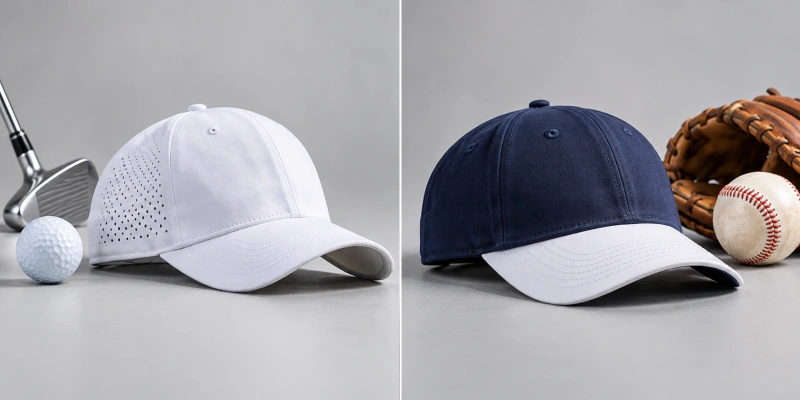
Are Golf Caps and Baseball Caps Actually Different?
The terms answer different questions. “Baseball cap” usually describes a recognizable construction: a fabric crown with a visor projecting from the front. “Golf cap” often describes intended use or a range marketed to golfers. The categories overlap. A six-panel baseball cap can also be a golf cap if you choose its details for the course.
That overlap does not make the terms meaningless. When a buyer asks for a golf cap, you may reasonably investigate long periods outdoors, heat, perspiration, movement, club identity, and sponsor placement. A baseball cap brief might start from a broader range of retail or team uses. The final material and pattern still have to be stated in either case.
What Is a Golf Cap?
In a modern product discussion, a golf cap is headwear chosen for golf use. It may be a baseball-style cap, a rope cap, or another golf-oriented design. Some people also use “golf hat” for a visor or a style with more surrounding coverage. The name alone does not establish a single crown height, panel count, closure, or performance specification.
If your team wants a specific silhouette, send a reference image. Explain whether the cap is for active play, club retail, or an event giveaway. A performance-minded on-course version may call for a lighter shell and carefully selected sweatband. A club shop version may put more weight on the fabric hand, color, and everyday appearance. Both can be legitimate golf caps.
What Is a Baseball Cap?
A baseball cap is a broad family of front-visor caps, available in different panel layouts, crown profiles, brim shapes, structures, and closures. The classic six-panel shape is familiar, but five-panel fronts and other variations also belong in the conversation. You can specify a soft, unstructured crown or a supported front; neither construction is inherently unsuitable for golf.
This broader definition matters when you order. If you say only “baseball cap,” a supplier still needs to know the fabric, fit, brim, sweatband, and decoration. If you say “golf baseball cap,” add the playing conditions and wearer priorities so the product can be judged against that use rather than its name.
Key Differences Between Golf Caps and Baseball Caps
Crown, Brim and Overall Construction
Golf caps often borrow the same crown and visor architecture as everyday baseball caps. A lower, softer crown may feel relaxed in a pro shop collection, while a structured front may hold a crisp club crest. A five-panel front can provide a relatively uninterrupted area for artwork; a six-panel front usually introduces a center seam. Pattern, seam placement, fabric, and reinforcement determine the usable area on the actual style.
Many golfers choose a curved visor because the shape feels familiar, but golf caps do not all have a prescribed brim length or curve. Baseball caps can likewise be curved or flat. Review the visor’s width, stiffness, angle, and position on the wearer. When you look down to address a ball, the brim should sit comfortably and preserve the sight line you want. A flat indoor photograph cannot settle that question.
The visor primarily shades part of the face. A conventional front-visor cap leaves the ears and back of the neck exposed, and its shade changes with sun angle and fit. Neither “golf” nor “performance” establishes a tested UPF rating. If a quantified sun-protection claim is part of your brief, ask for evidence tied to the specific fabric and finished construction.
Materials, Sweatbands and Ventilation
You can make a golf cap in cotton, polyester, nylon, or a blend. The fiber name by itself does not prove that a finished hat is light, cool, moisture-wicking, or quick-drying. Weave, weight, finish, lining, front support, and decoration all change the result. Cotton twill might suit a classic club collection; a selected lightweight synthetic may better fit a warm-weather playing brief. Compare physical samples under your expected conditions.
The sweatband deserves attention because it contacts the forehead for the entire round. Ask about its width, feel, absorbency direction, and behavior after it becomes damp. A cap can be comfortable in a five-minute fitting and uncomfortable after prolonged use.
If moisture management is important, state the required outcome and test the complete decorated sample rather than accepting a generic material label. Our hat materials guide explains the wider fabric choices; your comparison here should stay focused on the cap’s intended use.
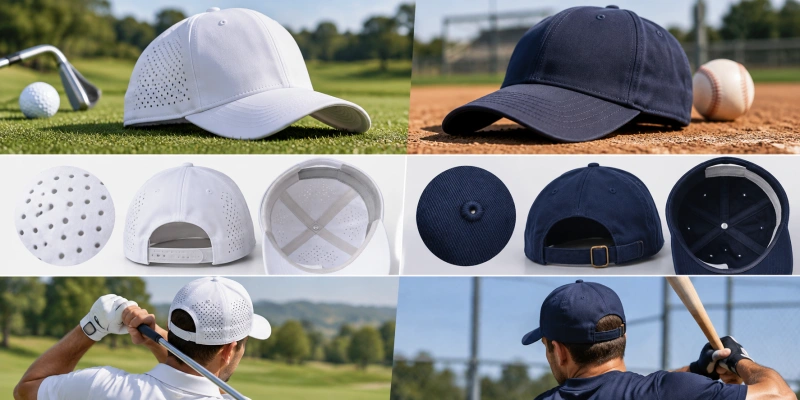
Ventilation also depends on details. Sewn eyelets, side perforations, selected breathable fabrics, or mesh areas offer different appearances and airflow paths. A mesh back may suit a casual golf event but changes the silhouette; subtle side ventilation can preserve an all-fabric look. A large embroidered front can alter weight and airflow around the same crown. Ask to inspect the finished hat with its intended logo.
Fit and Closure
A cap needs to sit securely without pressure points when you turn your head, walk, and bend. Crown depth, internal circumference, visor position, and front support matter as much as the nominal size. A golf-oriented cap is not automatically lower profile or better fitting than a general baseball cap. Compare representative wearers and include more than one head size when the program serves a broad group.
Rear closures can include adjustable straps, buckles, hook-and-loop fasteners, snapbacks, or other solutions depending on the style. None defines a golf cap. For an event where individual sizes are unknown, adjustability may simplify distribution, but a single adjustable range may still miss some wearers.
Check the actual range, the feel of the closure, and how the cap sits after adjustment. For a premium retail line, you may instead prioritize the appearance and hand feel of a particular closure.
Performance and Outdoor Comfort
For extended outdoor wear, you should assess fabric weight, airflow, sweatband feel, and fit together. A light fabric with a heavy patch may not feel as light in the finished product. A breathable shell with a dense internal reinforcement may perform differently from an undecorated swatch. The most useful comparison is between complete samples worn in comparable conditions, preferably for more than a brief indoor try-on.
Sun exposure is another design consideration, but shade and tested fabric protection are separate questions. A front visor provides limited facial shade; it does not offer the coverage of a wider brim around the head.
If your program requires ear and neck shade, consider a different golf headwear style rather than expecting a standard cap to provide it. If you make claims about UV protection, water resistance, or drying, define the test and documentation before placing them in product copy.
Style and Typical Uses
A classic baseball cap moves easily across teams, casual merchandise, staff uniforms, and promotions. On a golf course, the same silhouette can carry a club crest or sponsor mark without feeling out of place. Golf-oriented versions often use a cleaner athletic treatment, selected performance details, or a club-specific color scheme, but those are design decisions, not universal definitions.
Think about where recipients will wear the cap after the event. For a pro shop, off-course appeal can matter alongside comfort during play. For a tournament, a cap might need broad fit tolerance and a clear sponsor hierarchy. For a team uniform, consistency across repeat orders may be more valuable than adding a feature that few wearers need. State the use first and let it guide the specification.
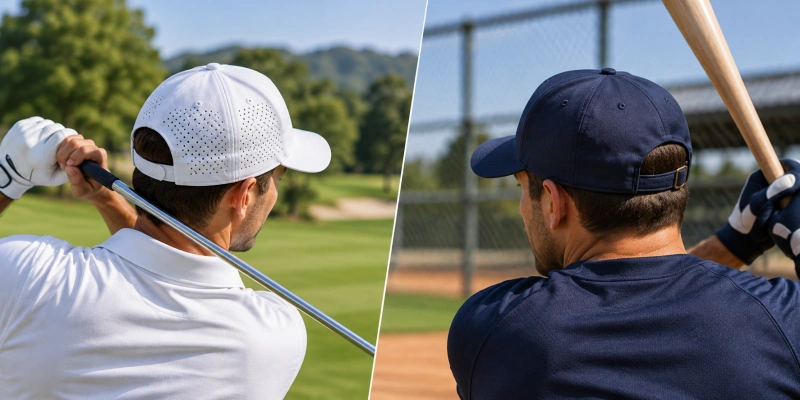
Which Should You Choose: a Golf Cap or a Baseball Cap?
Choose a golf-oriented specification when your wearers will spend extended time playing outdoors, and the fabric, sweatband, airflow, fit, and visor need closer review. This may still be a baseball-style cap. Start with the season, climate, length of use, and level of activity; then compare decorated samples. If your program includes several forms of headwear, the custom golf hats range offers cap, rope, visor, and other golf-oriented starting points.
Choose a more general baseball-cap specification when your priorities include everyday wear, team identity, staff distribution, retail merchandise, or a familiar shape that can cross several settings. You can still add details suited to golf. The custom baseball caps range is a practical starting point if your project calls for broad choices in crown structure, fabric, brim, and decoration.
If one program serves both golfers and non-golfers, compare two samples side by side: one optimized for prolonged outdoor wear and one for your preferred general appearance. Evaluate fit, decoration, and budget against the same audience. You may decide that one thoughtfully specified cap covers both needs, or that two styles give wearers a meaningful choice. Avoid treating the category names as a substitute for that decision.
Golf Cap vs Baseball Cap for Custom Branding
The cap’s front visor and crown make both categories useful for a visible club or team mark. The label “golf” does not create extra logo space. Artwork size, panel seams, crown height, front reinforcement, fabric texture, and chosen decoration determine what will actually look clear. Plan the mark on the proposed pattern, not on a generic cap mockup.
Logo Placement and Decoration Options
Front embroidery is a familiar option for a simple crest or wordmark. Depending on the artwork and selected cap, you can also assess patches, printing, or transfers; each needs a suitable surface and production review. A center seam may affect small lettering or a fine mark.
Dense embroidery and a large patch can alter the feel of a lightweight golf cap, so check both appearance and comfort on a decorated sample. The baseball cap logo design guide goes deeper into artwork scale and production choices.
For a club or tournament, decide which mark leads. A club crest on the front, sponsor at the side, and event name at the back may be possible on a chosen design, but each position has its own usable area. A low crown may leave less vertical room for a tall logo. Ventilation areas, seams, and closures can limit side or rear placement. Approve front, side, and back views at real size before ordering multiple colors.
What Custom Buyers Should Specify Before Sampling?
Write a brief that a supplier can use to build and evaluate one complete cap. Include:
- Intended use and target market: on-course play, club retail, tournament, team, staff, or promotion; note climate and typical wear time.
- Fabric and fabric weight: describe the desired hand and appearance, and identify any specific performance claim that requires testing.
- Crown profile and structure: low, mid, or high direction; structured or unstructured front; panel layout and fit reference.
- Brim shape: preferred curve, stiffness, width, and a reference photograph if the shape is important.
- Sweatband and ventilation: contact feel, material direction, eyelets, perforations, or mesh positions.
- Closure and sizing: closure type, adjustment range, and representative wearer sizes.
- Logo method and placement: usable artwork files, target dimensions, decoration method, positions, and colorways.
- Sample approval: check fit, brim position, sweatband, airflow, logo clarity, alignment, and color on the actual finished cap.
Add estimated quantities per style and color, labels, packaging, destination, and target date to your inquiry. Available fabric, color, decoration, minimum quantity, and lead time should be confirmed for the selected design and order.
A drawing or screen color cannot replace an approved physical sample. If your brief starts with a familiar visor cap, share it through the custom baseball caps page with these details; this gives the factory a more useful starting point than the words “golf cap” alone.
FAQs
Are Golf Caps and Baseball Caps the Same?
They can be. Many golf caps are baseball-style caps selected or specified for golf. “Baseball cap” usually refers to the front-visor construction; “golf cap” often refers to intended use. Ask for the exact crown, fabric, sweatband, ventilation, and fit rather than assuming either label guarantees those details.
Can You Wear a Baseball Cap for Golf?
Yes. Choose a cap whose fit, visor, fabric, and sweatband work for your playing conditions. A familiar baseball cap may be entirely suitable; for long, hot rounds, you may want to compare it with a lighter or better-ventilated sample. Test the finished hat instead of relying on the product name.
Which Is Better for Custom Logos, a Golf Cap or a Baseball Cap?
Neither label is automatically better. A clear logo depends on the crown profile, panel seams, front structure, fabric, decoration method, and actual artwork size. If your design includes sponsors, review side and rear placements on the same decorated sample. Choose the specification that shows your marks clearly while meeting the wearer’s comfort needs.
Choose the Cap That Fits Your Brief
A golf cap may be a baseball cap built for golf use. You make a better decision by comparing finished construction and wear conditions than by debating labels. Decide who will wear the cap, where it will be used, and how the logo must appear; then approve a sample with the intended fabric, sweatband, visor, fit, and decoration. HENGXING can use that brief to discuss the appropriate custom baseball cap options for your program.