
If you are choosing a rear closure for a custom cap, strapback vs. snapback is a comparison of how the cap adjusts and how its back looks. A snapback uses interlocking plastic tabs and holes that fasten at set positions. A strapback uses a strap, often made of fabric or another suitable material, that passes through a buckle or slider.
The exact strap, hardware, and way its free end is secured depend on the design. Both can be adjustable; neither name tells you the complete cap shape or how it will fit your intended wearers.
For a brand or bulk order, look beyond a product label. Decide what should appear at the back, test the adjustment on actual wearers, and approve the closure with the finished crown, brim, and logo. This guide helps you choose a direction, write a brief your supplier can act on, and check a sample before production.
Strapback vs Snapback: The Short Answer
Choose a plastic snap closure if its visible, stepped adjustment and rear appearance suit your cap. Choose a strap and buckle or slider when that material and hardware combination better fits your design. A strap often allows adjustment along the usable length of the material, while a snap fastens at its molded positions.
Actual size range, stability, and comfort still depend on the complete cap and the particular components; do not rank one closure as universally better.
In retail language, “snapback” may also name a whole style of cap, often pictured with a supported crown and flat brim. Here, the comparison is specifically about closures. You can pair a snap with different crown heights and flat or curved brims where the selected pattern allows it. A strapback does not have to be a soft dad hat. Treat the crown, brim, panel layout, and rear closure as separate specifications.
Are We Comparing Closures or Cap Styles?
The difference between a snapback and a strapback starts at the back opening. It does not settle whether the cap has five or six panels, a structured front, a low crown, mesh panels, or a particular visor curve. A familiar sample may combine several of those features, which can make the closure seem responsible for a silhouette it did not create.
HENGXING’s custom snapback hats range, for example, includes different brim and crown directions while keeping the plastic snap as the defining rear feature. Its broader baseball cap range lists plastic snaps alongside fabric straps, buckles, and other options.
If you are asking a supplier to change only the rear fastening, keep the other design features fixed in your sample brief where feasible. If a different construction is necessary, record that change so you can judge the complete alternatives fairly.
When you speak with a designer or supplier, say which aspect of the reference you mean. “I like this snapback” might refer to the plastic closure, the front shape, or both. Point to the back in a photograph and name the feature. The same clarity matters if your team uses “strapback” as shorthand for an entire relaxed cap; the strap does not define every other detail.
Strapback vs Snapback at a Glance
The table describes typical adjustment mechanisms and the questions to ask about the finished sample. The supplied parts, range, and finish must be checked for your selected cap.
| Decision point | Strapback closure | Snapback closure | Confirm on the sample |
| Adjustment | Strap moves through a buckle or slider over its usable length | Plastic tabs engage a series of molded positions | Fit at small, middle and large settings |
| Rear view | Visible strap, hardware, and possibly a free end | Visible plastic snap strips and opening | Color and appearance while worn |
| Material choice | Strap and hardware vary with the design | Plastic snap color and component vary with the design | Approved material and color reference |
| Tail management | Loose end may need a keeper or tuck-in solution | No separate fabric tail in the basic snap construction | Back view at representative settings |
| Decoration space | Strap, buckle and rear opening affect labels | Snap strips and rear opening affect labels | Position and legibility of rear branding |
| Inspection | Check strap travel, buckle grip and stitching | Check engagement, release and attachment | Approved fit and finishing criteria |
Neither column proves a fixed price, service life, or universal adjustment span. If a value matters to your program, request the actual component specification, an approved sample and any agreed test evidence.
How Does Each Back Closure Adjust?
A snapback has two mating plastic strips. The wearer selects a position and presses the fasteners together. Adjustment happens in steps defined by the component. Check how readily the parts engage and release, whether the selected position stays secure in ordinary wear, and whether the ends sit neatly against the back of the cap. The number of usable positions and total range are specific to the component and cap pattern.

A strapback works differently. A fabric strap, for instance, passes through a metal buckle or slider and is pulled to the desired position. The adjustment can be made between points rather than at molded snap intervals, within the strap’s usable travel.
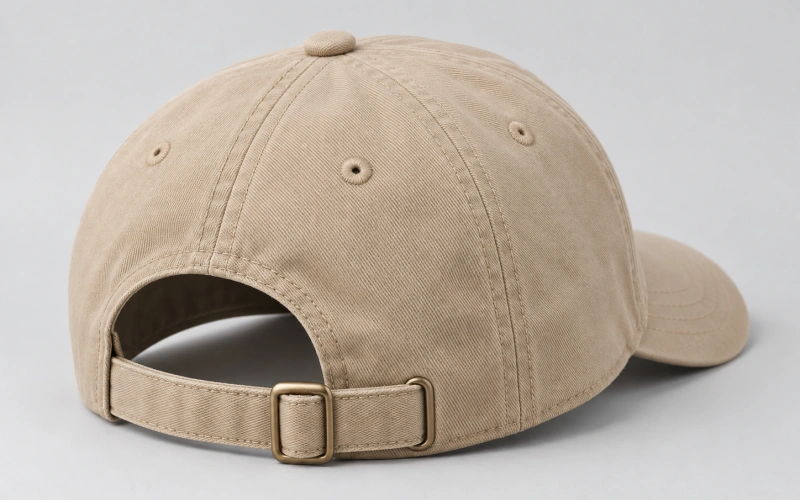
Some designs leave a visible tail; others provide a way to tuck or secure it. Buckle shape, strap width, material thickness, and rear opening all affect how the assembly handles. A leather strap and a cotton strap should not be assumed to behave alike merely because both are called strapbacks.
Ask your supplier to show the closure from outside and inside. On a strap version, inspect the path of the material through the hardware and how the tail is retained at both short and long settings. On a snap version, inspect the mating parts and how the plastic is attached to the cap. A rear photograph with the fastening closed can conceal a rough inside edge or an awkward free end.
HENGXING publishes plastic snaps and fabric straps with metal buckles or sliders among its custom hat closure options. These are starting directions for a project. Confirm the exact materials, widths, hardware finishes, and compatibility with the chosen cap before writing them into a purchase order.
How the Closure Changes the Rear View?
The back of a cap is a visible part of your product. A plastic snap can match the crown color or become a deliberate contrast. A fabric strap may blend into the body material, while a buckle or slider adds a separate finish. Either can work in a branded collection. The question is which rear view belongs with your intended front profile, colorway, and customer expectations.
Look at the cap on a person, not just on a table. At a small setting, a longer strap tail may be visible; at a large setting, the rear opening and amount of exposed strap change. A snap closure likewise shows a different amount of overlap as the wearer moves between positions. If you want a consistent back view across a range of wearers, photograph the sample at several settings and decide what variation is acceptable.
Rear decoration needs the same attention. A woven tab, small embroidery, or label near the opening may look clear when the cap is laid flat yet be partly hidden by a strap tail or snap strip when worn. Mark the artwork’s finished position relative to the opening and closure. If a strap itself carries a logo, approve the mark at the adjustment settings you expect customers to use.
A mockup cannot establish how the tail, hardware, and label interact in three dimensions.
Which Closure Should a Bulk Buyer Choose?
If you are choosing a snapback or strapback for a retail collection, begin with the reference product and the expected back view. Is the plastic fastener part of the style language, or do you want the texture of fabric and hardware to continue around the cap? Compare the alternatives in the same colorway and with the same front artwork. Let your buyers evaluate the cap as a whole, while recording comments specifically about the rear fastening.
For team or event merchandise, ask how people will receive the caps. Will they try them on, select from several sizes, or take one at distribution? Test the chosen closure on people across the intended head-size range. A closure can be adjustable without making the underlying crown suitable for every wearer.
If the extreme settings do not work well, discuss a different cap pattern or size plan rather than assuming a different buckle alone will solve the fit.
For a corporate or promotional program, consider whether the back detail must coordinate with uniforms, other merchandise, or a particular brand finish. A subdued fabric strap can be a candidate; a matching plastic snap can also be discreet. Those are design hypotheses, not rules for every client. Your sample and intended audience should make the decision.
If your direction is a relaxed cap with a fabric strap, HENGXING’s custom dad hats show relevant strap and buckle examples. A dad hat is only one possible application of a strapback closure. If the visible plastic snap is central to the brief, explore the custom snapback hats range. For another crown or an undecided base style, begin with custom baseball caps and specify the closure separately.
Compare Like-for-Like Samples Before Approval
The cleanest comparison uses the same cap base with two rear closures, if that combination can be developed. Keep the crown pattern, panel count, fabric, brim, color, logo, sweatband, and target size range consistent. Label version A as the strap and version B as the snap.
If changing the closure requires a different back opening, seam, or panel pattern, put that difference on the review sheet. You are then comparing two complete assemblies, not an isolated fastener.
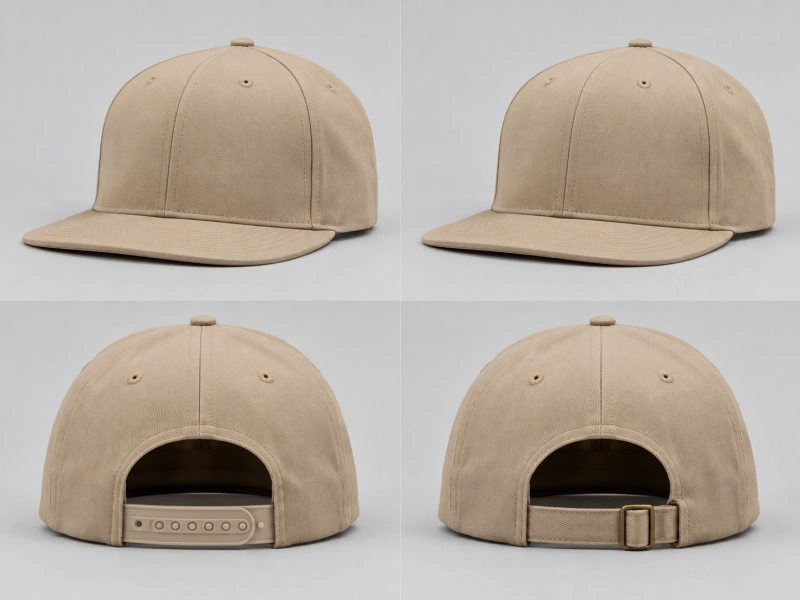
Photograph each version from the front, side, back, and inside under the same lighting. Add worn back views at several settings. Ask reviewers to try both rather than making a decision from product images alone. Note the head measurement or size category, adjustment setting, and whether the crown sits where intended. A person who says “the snap feels tighter” may actually be responding to a different crown depth or sweatband.
Use a short feedback form with distinct questions: Which rear appearance fits the collection? Can you adjust it easily? Does the closed fastening sit comfortably? Does the cap remain stable during ordinary movement? Is a label or tail in the way? Ask for specific observations, not a single vote. If you cannot obtain matched samples, identify the other differences before attributing feedback to the closure.
Record the selected sample version and retain the rejected version as a comparison reference. Do not carry an unapproved strap color or snap component into production because both samples used a similar cap body.
What to Put in Your Closure Tech Pack?
Start with the base cap pattern and the intended head-size range. For a snapback, identify the plastic closure type, color, placement, and approved physical component or reference. State how you want the rear opening and nearby stitching to appear.
For a strapback, specify the strap material, width and color, buckle or slider type and finish, how the strap is attached, and how its loose end should be managed. If you have a reference cap, mark exactly which feature you want reproduced.
Include the location of any rear embroidery, tab, or label and provide artwork at the intended finished size. Add the crown, brim, fabric, and sweatband details that must remain the same across versions. Include your estimated quantity by colorway and version, intended wearer group, preferred packaging, and delivery destination.
If you need a particular adjustment span or strength requirement, ask how it will be measured and verified; do not invent a tolerance from an unrelated style.
A practical brief can use these fields:
- Base cap and reference sample ID; crown, brim, fabric and color.
- Closure version: plastic snap or strap with named buckle or slider.
- Closure material, color, finish, width, and attachment details, subject to project confirmation.
- Rear opening, tail storage, and back-label or logo placement.
- Intended head-size range and fit sample group.
- Estimated quantity by version and colorway; sample and approval requirements.
Send the brief with rear-view photographs or a physical reference. HENGXING’s published customization process accepts artwork and project specifications for review and provides a physical sample for approval. Availability, component details, minimum quantity, and timing need confirmation for the proposed construction; a previous order or product page does not settle them automatically.
Check Fit, Hold and Finishing on the Sample
Begin by adjusting the finished cap on several intended wearers. At each representative setting, check the sweatband position, crown depth, and stability, then examine the back. On a snapback, fasten and release the components repeatedly during sample review and look for incomplete engagement, awkward contact, or misaligned attachment.
On a strapback, move the strap through its useful range, check how the buckle or slider holds the selected position, and look at the free end while the cap is worn.
Inspect the inside seams and attachment stitching. A well-presented back view is insufficient if a loose edge presses on the wearer or the closure pulls the rear opening out of shape. Check that a label remains visible and that the hardware or plastic color matches the approved reference in ordinary light. Photograph any issue and attach it to the relevant sample version.
If your program requires evidence of repeated adjustment, pull strength, colorfastness or corrosion performance, agree on a test method and pass criteria with the supplier. The general words “durable” and “premium” cannot substitute for project-specific evidence. Record the accepted sample, agreed measurements, and any deviations before bulk production. For a broader fit check, use HENGXING’s guide on how a baseball cap should fit.
FAQs About Strapback and Snapback Caps
Are Strapback and Snapback Hats the Same?
They describe different rear adjustment mechanisms. A snapback uses interlocking plastic fasteners; a strapback uses an adjustable strap with a buckle, slider, or other specified hardware. Both may be fitted to baseball-style caps. The complete hat can differ in crown, brim, and fabric, so read the actual specification when comparing two products.
Does a Snapback Always Have a Flat Brim?
No. Flat-brim snapbacks are familiar, but the plastic closure can also be paired with a curved brim where the cap design supports it. Confirm the supplied brim shape on a finished sample rather than inferring it from the rear closure. A brim change can alter the visual balance of the whole cap.
Is a Strapback Always a Dad Hat?
No. A fabric strap and buckle are common on many relaxed dad-hat designs, but strapback names the closure. A supported baseball cap may also use a strap-based adjustment depending on its pattern. Specify the crown and front structure separately if you want a particular silhouette.
Which Closure Fits More Head Sizes?
You cannot tell from the closure name alone. A snap’s position, a strap’s usable travel, and the cap’s crown pattern jointly determine the practical range. Try the actual sample on representative wearers and record settings. If a single size does not cover the intended group, discuss a revised pattern or an additional size.
Can You Use Both Closures in One Collection?
Potentially, subject to development and project review. Treat each as a separate version with its own sample, rear-view photographs, specifications, quantities, and approval record. Even when the front design matches, the back opening and artwork placement may need adjustment. Confirm feasibility, price, and production terms for both rather than assuming they are identical.
Ask HENGXING to Review Your Closure Brief
Send your target cap shape, clear rear photographs or a physical reference, artwork, intended wearer group, estimated quantity, and the two closure directions you want to compare. State any back label, strap-tail, or color requirement.
HENGXING can review the custom hat closure options against your proposed design and discuss the sample scope. Approve the complete cap, including its fit and rear appearance, before using it as the production reference.