
A baseball cap should feel secure without sustained pressure. It should sit evenly where you intend to wear it and remain in place during normal movement. On an adjustable cap, the closure should have usable room on either side of a comfortable setting.
If a baseball hat presses at the sweatband, slides around, or rides up, check both its size and shape. The right fit depends on the cap’s pattern and your head shape, so there is no single eyebrow or ear clearance that works for everyone.
Four Checks for Baseball Cap Fit
Try the cap in the position you would normally wear it, then make these four checks before judging the size label.
Check Where the Cap Sits
The sweatband should meet your head evenly rather than forcing the cap down at the front or leaving the back noticeably raised. Look in a mirror from the front and side. The brim can sit higher or lower according to the design and the wearer’s preference, but the cap should not need to be pulled into an unnatural position to stay on.
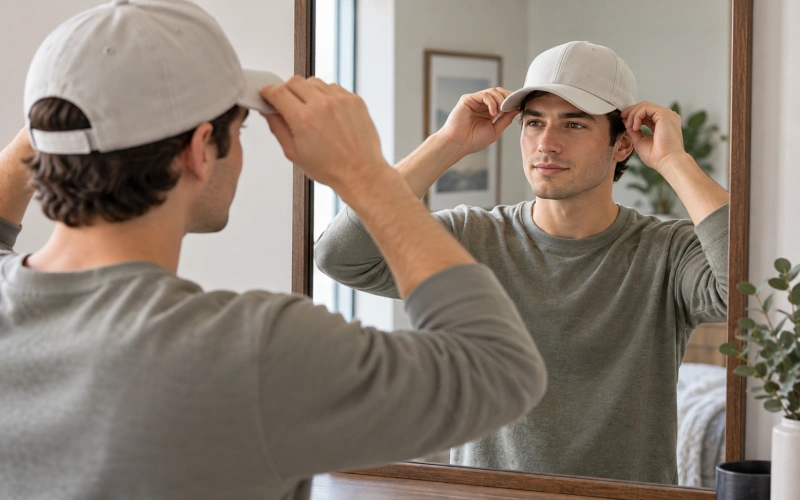
Check the Pressure Around the Sweatband
A secure fit should not create persistent pressure at the forehead, temples, or back of the head. A brief impression from the band is not, by itself, a universal sizing test; discomfort and pronounced pressure marks are better reasons to reassess the fit. Also check whether an internal seam or sweatband edge, rather than the overall circumference, is causing a local pressure point.
Check Stability During Ordinary Movement
Turn your head, look down, and move as you expect to while wearing the cap. It should remain reasonably stable without feeling clamped on. If an adjustable cap slips, tighten the closure slightly. If a fitted cap slips, compare another size or crown shape.
If an adjustable cap stays in place only at the limit of its closure, the underlying size or shape may still be wrong. A cap intended for strenuous use may need a different fit test from a cap for everyday wear.
Check Crown Depth and Adjustment Room
The crown should cover the head as the design intends. If the top of the cap meets your head before the sweatband reaches a comfortable position, the crown may be too shallow for you. If excess material bunches above the head or the front stands farther away than intended, a different profile or pattern may work better. On an adjustable cap, note how much usable adjustment remains after you find a comfortable setting.

Signs of a Poor Baseball Cap Fit
A poor fit does not always mean you need the next size. Use the symptom to decide what to test first.
| What you notice | What it may mean | What to check next |
| Persistent pressure or a strong mark at the sweatband | The circumference may be too small, or one area may be creating a pressure point. | Loosen an adjustable closure if possible, then inspect the sweatband and compare the next size or a different pattern. |
| Sliding or turning during normal movement | The band may be too large or the closure may not hold the cap securely. | Adjust the closure; if the cap remains loose, compare a smaller size or another shape. |
| The crown rides up even though the band feels snug | Crown depth or head shape may be the issue rather than circumference alone. | Compare the crown depth and front shape with a cap that sits comfortably. |
| Gaps or bunching at the sides or top | The crown pattern may not follow the wearer’s head shape. | Compare a different profile or construction before changing only the size. |
Why the Right Head Circumference Can Still Feel Wrong?
Head circumference measures the distance around the head, but it does not describe the crown’s depth or shape. Two caps with the same nominal size can feel different because their panel patterns, front support, sweatbands, fabrics, and closures differ. A structured front maintains a more defined shape; an unstructured front is softer. Neither construction automatically means a larger or smaller fit.
Crown profile also changes how a cap sits and looks. A low-profile cap has a shallower appearance than a high-crown cap, but ‘low profile’ is not a substitute for a small size. When a cap feels wrong despite a plausible head measurement, compare the actual sample with a familiar cap and identify whether the problem is around the band, above the head, or at the front panels.
Fit Checks by Sizing System
| Cap type | Fit check | Common mistake |
| Fitted | Compare your head measurement with that product’s size chart, then try the actual crown shape. | Assuming the same numeric size feels identical across brands or patterns. |
| Adjustable | Find a comfortable band setting and check that the cap stays stable with practical adjustment room. | Treating an adjustable closure as proof that every wearer is covered. |
| Stretch fit | Check whether the elastic band remains comfortable and secure during normal movement. | Judging fit from the size label without trying the stretch band. |
A size label is a starting point, not a substitute for trying on the cap. If you need to measure, use a flexible tape around the head where the sweatband will rest, keep it level and comfortably snug, and compare the result with the chart for the specific cap. HENGXING’s baseball cap size chart and measurement tool can help you compare measurements; the wear test confirms how the actual cap fits.
Fit Checks for Custom Baseball Cap Samples
For a custom order, ‘fits well’ is too vague to guide revisions or approve a bulk run. Define the intended fit before sampling, then repeat the same checks on each revision. This matters for a retail collection, team merchandise program, or staff uniform.
Set a Fit Brief Before the Sample Is Made
Give the supplier a reference cap or clear front, side, and back photos. Define the target wearers, head-size range, crown profile, front structure, closure, and desired fit. For multiple sizes, identify which size each sample represents and explain what to retain or change from the reference.
Test the Physical Sample on Intended Wearers
Have intended wearers try each sample. Record their head measurements, cap size or closure setting, and consistent front, side, and back photos. Check sweatband pressure, stability, crown depth, brim position, and remaining adjustment. Locate any pressure or slipping instead of labeling the whole cap ‘too small’ or ‘too big.’

Approve the Revised Fit With a Clear Record
Compare the results with the fit brief and reference cap. Note whether the pattern, depth, sweatband, or closure needs revision, and record each change. Keep the accepted sample with its confirmed specifications so the correct version guides bulk production.
At HENGXING, fit and closure are reviewed during project scoping, and a physical sample can be checked and adjusted before specifications are approved for bulk production. The checklist below helps buyers report fit consistently. Agree on any measurable tolerances for the specific design before approving the sample.
| Record for each sample | Why it matters | Decision to capture |
| Target wearer and head measurement | Shows which intended size point the trial represents. | Confirm coverage or request another size sample |
| Front, side, and back fit photos | Makes crown position and silhouette easier to compare across revisions. | Accept shape or request a change |
| Sweatband feel and movement test | Separates local pressure and slipping from visual preference. | Accept or identify the problem area |
| Closure setting and adjustment room | Shows whether the fit relies on the edge of the closure range. | Accept or review closure and sizing |
| Sample version and approved specifications | Keeps the final fit decision tied to the correct sample. | Approve for bulk or revise and retest |
FAQs
Where should a baseball cap sit on your head?
It should sit evenly where the design is meant to be worn, with the sweatband making comfortable contact around the head. The brim’s height can vary by style and preference. Check that you don’t have to force the cap unusually low or tip it back to feel secure.
How tight should a baseball cap fit?
Tight enough to stay in place during normal movement, but not so tight that it causes sustained pressure. If loosening the closure removes discomfort but makes the cap unstable, try another size or crown shape rather than assuming the closure alone can solve the fit.
Why does my baseball cap ride up?
The crown may be too shallow for your head shape, or the cap may be sitting in a position the pattern does not support. A tight band can also make the problem more noticeable. Compare the crown depth and band position with a cap you can wear comfortably.
Can an adjustable baseball cap still be too small?
An adjustable closure has a limited range and cannot change crown depth or shape. If the band still presses at its loosest useful setting, or the crown doesn’t sit as intended, you may need a different size or pattern.
Check the Sample Before You Approve the Order
The best fit decision uses both measurement and a physical try-on. For a custom program, record who tested the sample, how it sat, what needed changing, and which version was approved. If you are developing a branded cap, explore HENGXING’s custom baseball cap options and share your target wearer, reference cap, and fit requirements when you request a sample or quotation.