
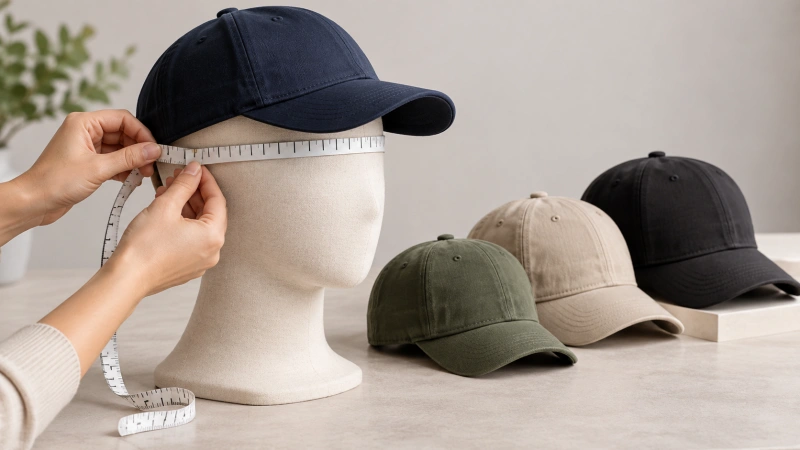
Baseball Cap Size Calculator, Chart & Fit Guide
Enter your head circumference to find a reference fitted baseball cap size. You can use centimeters or inches, then compare the result with the size chart below. Adjustable caps use a size range rather than a single fitted size.
Baseball Cap Size Calculator
Enter your head circumference in centimeters or inches. The calculator will show a reference fitted size and an approximate letter-size group. These results are a sizing reference, not the finished dimensions of a specific cap.
Baseball Cap Size Calculator
Enter your head circumference in centimeters or inches. The calculator will show a reference fitted size and an approximate letter-size group. These results are a sizing reference, not the finished dimensions of a specific cap.
Your Reference Size
Enter a head circumference to see a reference size.
Near a size boundary? Compare adjacent sample sizes.
Reference only: Cap sizing can vary by pattern, fabric and fit preference. For custom production, confirm the final fit with the supplier’s size chart and a physical sample.
Need a custom size range? Share your audience measurements, cap style and sample requirements. Explore custom baseball caps.
Reference only: Cap sizing can vary by pattern, fabric, and fit preference. For custom production, confirm the final fit with the supplier’s size chart and a physical sample.
How to Measure Your Head for a Baseball Cap
Use a flexible tape measure and measure your head rather than an existing cap. An old cap may have stretched, shrunk, or been made to a different pattern. If you are sizing a branded collection, measure people in the intended audience and record the range of results instead of relying on one sample wearer.
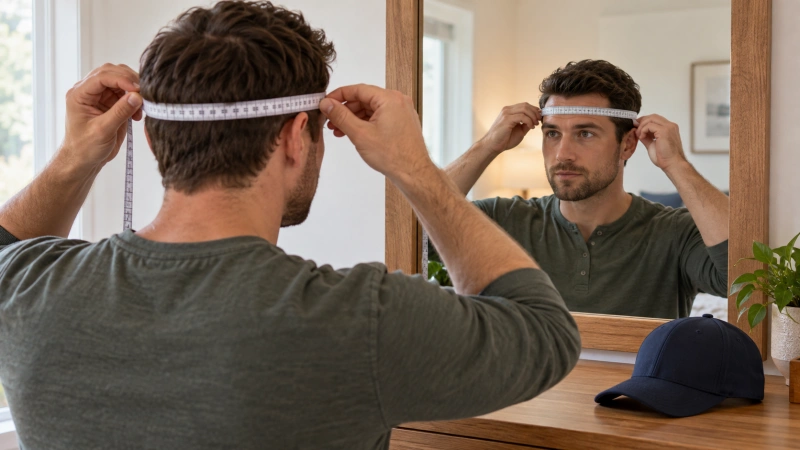
1. Place the Tape Where the Cap Band Will Sit
Place the tape across your forehead slightly above the eyebrows, continue above your ears, and around the widest part of the back of your head. Keep the tape level along the path where the sweatband will sit. If the cap is intended to sit higher or lower, measure at that position.
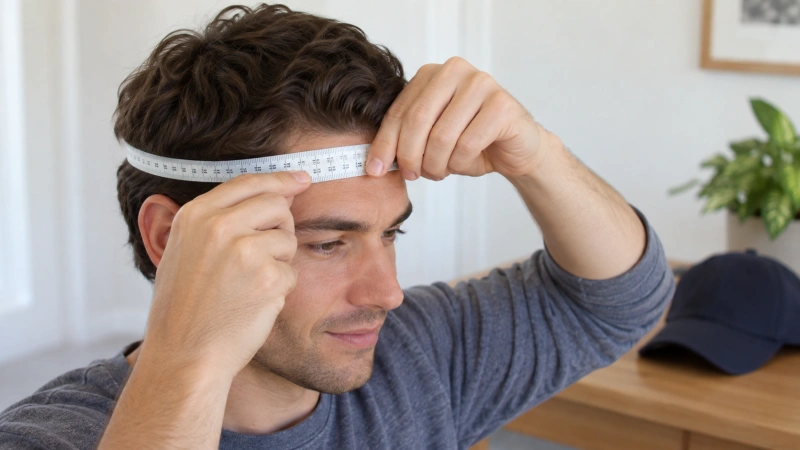
2. Keep the Tape Snug, Not Tight
Bring the ends together without pulling the tape tightly against your head. A tight measurement can make the size too small, while a loose measurement can make it too large. If you have thick hair or normally wear a particular hairstyle under the cap, measure your head as you would normally wear the cap. If you do not have a flexible tape, use a non-stretch string, mark the length, and measure it with a ruler.

3. Measure Twice and Record the Unit
Measure again to make sure the readings are consistent. Record the circumference in centimeters or inches, then enter it into the calculator or compare it with the size chart below. If you need to convert units, 1 inch equals 2.54 cm. If the two readings differ, reposition the tape and measure again. If your measurement is close to a size boundary, compare the adjacent sizes on a physical sample before choosing the final size.
Baseball Cap Size Chart: CM, Inches and Fitted Sizes
This chart compares head circumference with common fitted baseball cap sizes. The inch values are rounded references, and the S/M, M/L, L/XL, and XL/XXL groups are approximate. Actual sizing can vary by cap style and supplier. For example, 58 cm is about 22.8 in and matches the reference fitted size of 7 1/4 in in this chart. Another size chart may use slightly different measurements for the same size label. For custom production, confirm sizing against the chart for the selected cap style and a physical sample. The calculator above uses the same reference size rows.
| Lower Bound (cm) | Display (cm) | Display (in, approx.) | Fitted Size | Approx. Group |
|---|---|---|---|---|
| 53.5 | 54 | 21 1/4 | 6 3/4 | S/M |
| 54.5 | 55 | 21 5/8 | 6 7/8 | S/M |
| 55.5 | 56 | 22 | 7 | S/M |
| 56.5 | 57 | 22 3/8 | 7 1/8 | M/L |
| 57.5 | 58 | 22 3/4 | 7 1/4 | M/L |
| 58.5 | 59 | 23 1/8 | 7 3/8 | M/L |
| 59.5 | 60 | 23 1/2 | 7 1/2 | L/XL |
| 60.5 | 61 | 23 7/8 | 7 5/8 | L/XL |
| 61.5 | 62 | 24 1/4 | 7 3/4 | L/XL |
| 62.5 | 63 | 24 5/8 | 7 7/8 | XL/XXL |
| 63.5 | 64 | 25 | 8 | XL/XXL |
| 64.5 | 65 | 25 3/8 | 8 1/8 | XL/XXL |
| 65.5 | 66 | 25 3/4 | 8 1/4 | XL/XXL |
Matching Rule: Normalize inches × 2.54 without intermediate rounding. Match reference rows from 53.5 through 66.5 cm; row changes at half-centimeter boundaries. Outside this range, show “Outside chart.” An exact upper boundary of 66.5 cm maps to 66 cm; above 66.5 cm is outside. These row thresholds are planning rules, not factory tolerances.
How Fitted Baseball Cap Sizes Work
A fitted cap has no adjustable back closure, so the size is selected by head circumference. Fitted hat sizes are commonly shown in one-eighth increments, such as 7, 7 1/8, and 7 1/4. In the reference chart above, each step represents about 1 cm of head circumference. The fitted size is a sizing label for comparison, not a direct measurement of the cap itself.
Once you have your head circumference, compare it with the fitted size chart and find the closest reference row. If your measurement falls near a size boundary, compare the two adjacent sizes on physical samples. The final fit can also vary with the crown shape, sweatband, seams, fabric, and how low the cap sits on the head. For more about this cap construction, see what a fitted hat is.
One Size, Snapback and Strapback Sizing
Once you have your head circumference, compare it with the fitted size chart and find the closest reference row. If your measurement falls near a size boundary, compare the two adjacent sizes on physical samples. The final fit can also vary with the crown shape, sweatband, seams, fabric, and how low the cap sits on the head. For more about this cap construction, see what a fitted hat is.
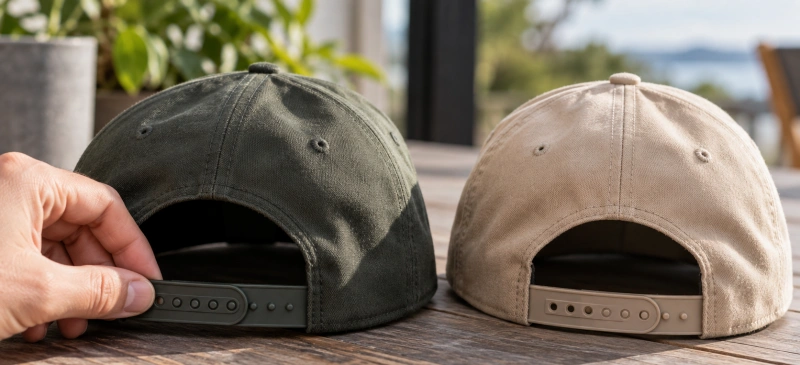
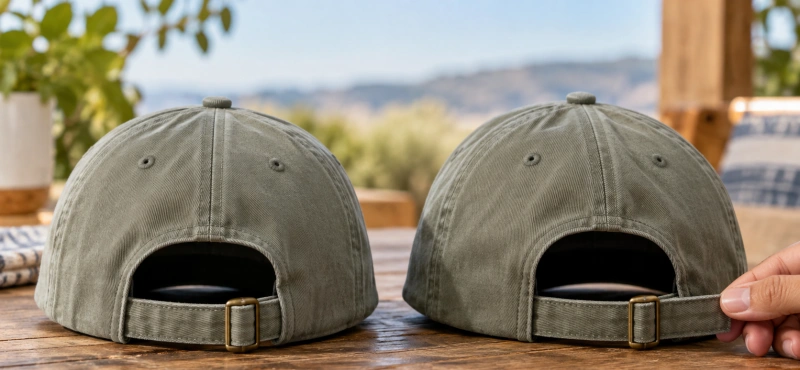
A one-size or adjustable label still refers to a limited fit range, so check the stated range for the specific cap. If you are deciding between a fixed fitted size and an adjustable plastic snap closure, see our fitted hat vs. snapback sizing comparison.
S/M, M/L, L/XL and XL/XXL: What Letter Sizes Mean
Letter sizes group a range of head circumferences. They are common on stretch-fit caps and may also be used on some fitted or adjustable styles. In the reference chart above, 54–56 cm is approximately S/M, 57–59 cm is M/L, 60–62 cm is L/XL, and 63–66 cm is XL/XXL. These ranges apply to this reference chart; other brands or cap patterns may use different cutoffs or overlapping ranges.
A letter size does not tell you the crown depth, brim shape or amount of stretch. For a bulk order, check the size range for the exact cap pattern and compare physical samples, especially when measurements fall near the edge of a size range.
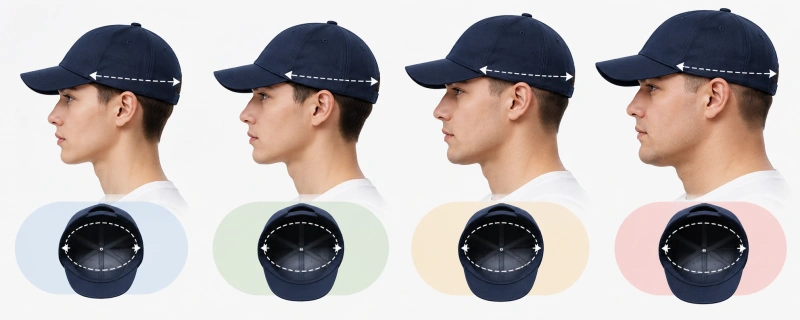
Between Sizes, Too Tight or Too Loose

If your measurement falls between two reference sizes, compare both. A cap may be too tight if it leaves pressure marks, feels uncomfortable around the sweatband or will not sit at the intended depth. A cap may be too loose if it slips, rotates easily or needs an adjustable closure to be tightened almost to its limit. Recheck your head measurement before changing sizes.
For a fitted cap, try the two nearest sizes and check the fit around the entire sweatband, not just at the sides. For an adjustable cap, test the fit near both ends of the intended size range. If the same fit problem appears across several samples, ask the manufacturer to review the cap pattern, sweatband and size range. Use physical samples to confirm the final sizing for production.
Why the Same Baseball Cap Size Can Fit Differently
Head circumference is the starting point, but two caps with the same stated size may not fit identically. Crown shape, cap pattern, fabric stretch, seams, and sweatband construction can all affect how the cap sits and feels.
A structured baseball cap may hold a firmer front shape, while an unstructured baseball cap can conform more closely to the head. Crown profile can also change how deep or shallow the cap feels without changing the head circumference. For custom production, compare the selected pattern and a physical sample rather than relying on the size label alone.
Youth and Kids Baseball Cap Sizes
Children’s cap sizing should be based on the child’s head circumference and the size range of the specific youth pattern. Do not use the adult fitted-size chart above as a youth sizing chart. Adjustable closures can provide extra range, but crown depth and the actual closure range still need to fit the wearer. For youth measurements and size ranges, see our kids’ hat size chart.
How Brands Specify Custom Baseball Cap Sizes
If you are developing custom baseball caps for a brand, distributor or team, a size label alone is not enough to define the order. Share the head-circumference range of the intended wearers and the cap style you want to sample. Specify whether the project uses fitted sizes, one adjustable size range, stretch-fit groups or separate adult and youth patterns. The reference chart can help with initial planning, but the approved sample and final specification should be used for production.
- Audience and size range: Who will wear the caps, and what head-circumference range should the order cover?
- Size system: Will the caps use fitted numeric sizes, letter-size groups or an adjustable closure with a confirmed range?
- Cap pattern: Confirm the crown profile, structure, panel construction, fabric, sweatband and closure for the selected style.
- Sample sizes: Identify which sizes, including sizes near the ends of the required range, should be tested.
- Finished measurements: Define the measurements and tolerances that need to be checked for the project.
- Production reference: Confirm which physical sample and approved size chart will be used for bulk production.

A request for “medium baseball caps” can mean different things. One buyer may need an adjustable cap that covers most adult wearers, while another may require several fitted sizes with a planned quantity for each size. Share your target measurements, expected size breakdown and sample feedback when discussing sizing with the manufacturer. The final size range, tolerances and available options should be confirmed for the specific cap pattern rather than taken from a general size chart.
FAQs
These FAQs cover common questions about baseball cap sizing, fitted sizes, adjustable caps and how to choose the right fit.
What Fitted Size Is 58 cm?
In this reference chart, a 58 cm head circumference corresponds to a fitted size of 7 1/4. That measurement is about 22.8 inches by direct conversion. Size charts can vary by brand or cap pattern, so check the chart for the specific style before making a final selection.
Is a One-Size Baseball Cap the Same as a Fitted Cap?
No. A one-size cap usually uses an adjustable closure or stretch to fit a range of head sizes, while a fitted cap is made in specific numeric sizes. Check the stated size range for the exact cap style.
Do Men’s and Women’s Baseball Caps Use Different Size Numbers?
Not necessarily. Head circumference is more important than a men’s or women’s label. Compare the measured head circumference with the size chart for the specific cap, because crown shape, depth and size range can still vary by style.
Does Crown Height Change Baseball Cap Size?
Crown height affects how deep or shallow a cap feels, but it is separate from head circumference. A low-profile cap is not automatically a smaller head size. Compare the stated size range and physical samples when crown depth is important for fit.
Measure the head circumference, use the calculator or size chart for reference, and then confirm the fit on the actual cap style. Crown shape, closure, and pattern can all affect how the same size feels.
For a custom order, share the target size range and preferred size system before sampling. Explore custom baseball caps and confirm the final size plan with the approved pattern and physical sample.