
A strapback hat is an adjustable cap with a strap at the rear. The strap usually passes through a buckle, slide, clasp or D-ring so you can change the circumference. Unlike a snapback, which uses interlocking plastic tabs and fixed adjustment holes, a strapback normally allows fine adjustment anywhere within its usable range.
“Strapback” describes the closure, not the entire hat. The crown can be structured or unstructured, high or low profile, and made with five or six panels. The brim can be flat or curved. Many dad hats use strapback closures, but the two terms are not interchangeable.
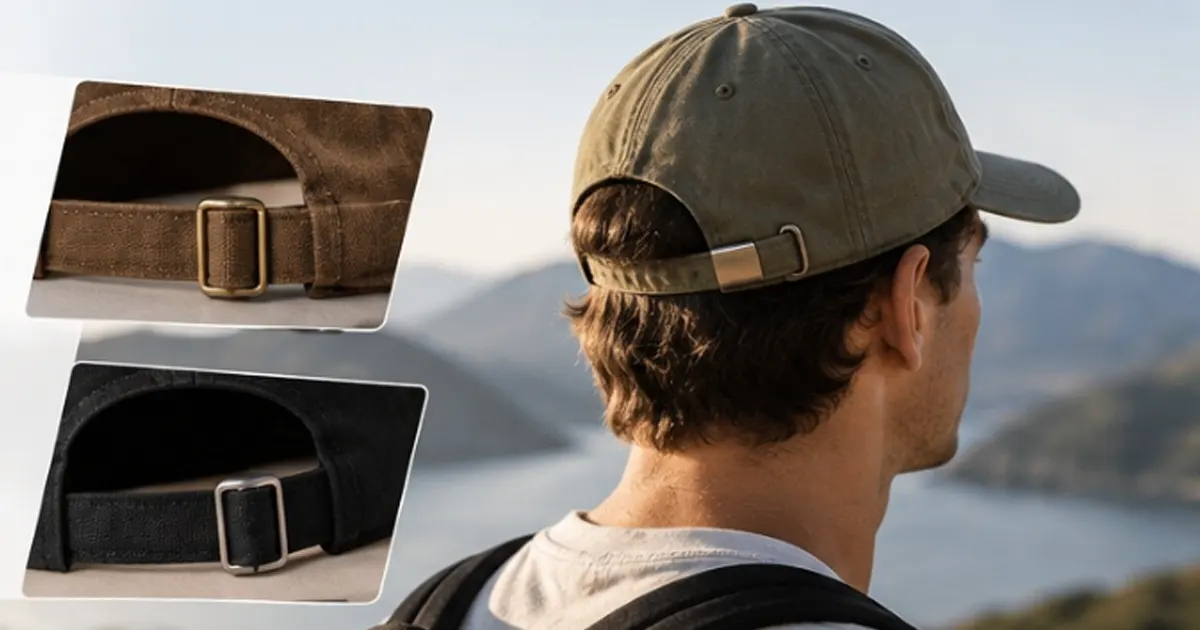
How a Strapback Closure Works
The rear opening removes part of the crown circumference. A strap bridges that opening and changes its width. Shortening the exposed strap tightens the hat; lengthening it loosens the fit. Hardware holds the selected position, while a keeper, loop or internal slot manages the loose end.
| Closure part | Function | What to inspect |
| Adjustment strap | Changes the usable circumference | Material, width, edge finish, reinforcement and length |
| Buckle, slide or clasp | Locks the strap at the selected position | Grip, corrosion resistance, sharp edges and ease of use |
| Rear opening | Provides space for adjustment and hair | Shape, edge binding, symmetry and pressure at the corners |
| Strap keeper | Controls the loose tail | Whether the strap stays flat and does not slip out |
| Anchor seam | Connects the strap to the cap | Reinforcement and resistance to repeated pulling |
| Sweatband | Contacts the head and supports the circumference | How it transitions into the rear opening |
The closure has to do two things at once: remain easy to adjust and resist slipping during wear. A smooth strap may slide through weak hardware; an aggressive clasp may grip well but mark delicate fabric. The best combination depends on material thickness and intended use.
Common Strapback Closure Types
Metal slide buckle
A fabric strap threads through a rectangular or curved metal adjuster. The friction created by the threading path holds the size. This system is common because it offers continuous adjustment and a clean appearance. Rounded hardware and a covered rear surface help prevent scratching.
Clasp buckle
A hinged clasp closes onto the strap. It is quick to release and can hold a repeatable setting, but the teeth or pressure surface must match the strap. Excessive grip can damage the fabric; insufficient grip allows gradual loosening.
D-ring closure
The strap passes through one or two D-shaped rings and doubles back. D-rings are simple and visually distinctive. They work best when strap texture and threading create enough friction to prevent creep.
Plastic slide adjuster
Plastic hardware is light and does not rust. It can suit sport, outdoor or washable designs, although resin quality, thickness and cold-temperature impact resistance influence durability.
Leather or leather-like strap with holes
Some closures use a small pin buckle and pre-punched holes. This looks refined and gives repeatable positions, but adjustment is limited to the hole spacing. The material may be genuine leather, coated textile or synthetic leather, so product descriptions should be precise.
What Are Strapback Straps Made From?
| Strap material | Typical character | Key considerations |
| Self-fabric | Uses the same fabric as the cap for a coordinated look | Needs suitable reinforcement and edge finishing to avoid stretching or fraying |
| Cotton webbing | Soft, matte and easy to handle | Can absorb sweat and may thicken after repeated washing |
| Polyester or nylon webbing | Strong, consistent and relatively quick drying | Slippery surfaces need compatible hardware; cut ends require secure finishing |
| Genuine leather | Distinctive natural appearance that can develop a patina | Care, color transfer, water exposure and material variation require attention |
| Synthetic leather | Consistent appearance and broad color options | Surface coatings may crack or peel with heat, abrasion and age |
| Elasticated strap | Adds some automatic give | Recovery can decline, and continuous tension may feel different across the size range |
A leather-looking strap should not automatically be described as leather. Accurate material labeling matters for care, sourcing expectations and durability. The same applies to “metal buckle”: the base metal, coating and exposure to salt or sweat affect how the hardware ages.
How Should a Strapback Hat Fit?
A strapback should make even contact around your head without creating pressure at the rear opening. The crown should settle into its intended position, and the brim should remain centered when you turn your head. The strap should not need to sit at the extreme end of its adjustment range.
How to adjust it
- Open or loosen the adjuster before placing the hat on your head.
- Set the crown at the intended height and center the brim.
- Shorten the strap gradually until the hat feels secure.
- Move your head and check for slipping or concentrated pressure.
- Lock the buckle or clasp fully.
- Tuck the remaining tail into its slot or keeper so it lies flat.
Pulling the strap as tight as possible does not create a better fit. Over-tightening can distort the rear panels, widen the opening, pull the brim off center and concentrate pressure around the strap anchor.
Signs the strap is too tight
- The rear opening spreads into an exaggerated shape.
- The closure presses against the back of your head.
- Panels wrinkle toward the strap anchors.
- You feel a pressure line within a few minutes.
Signs the strap is too loose
- The cap rotates or lifts in a breeze.
- The brim drops or shifts off center.
- The strap tail moves because the hardware is not under enough friction.
- The crown sits lower than intended.
Strapback vs Snapback
| Feature | Strapback | Snapback |
| Adjustment | Usually continuous within the strap range | Fixed increments defined by snap holes |
| Closure material | Fabric, webbing, leather or leather-like strap plus hardware | Interlocking plastic tabs |
| Rear feel | Depends on buckle, strap tail and opening finish | Depends on plastic arc and selected snap position |
| Visual character | Can look subtle, classic or refined | More visibly sport-derived and utilitarian |
| Repeatability | Fine adjustment, but some slides can creep | Easy to return to the same hole setting |
| Care concern | Hardware and strap material may need special care | Snaps can crack under force or heat |
Neither closure determines crown profile. You can build a structured high-profile strapback or a soft low-profile snapback. The rear hardware and adjustment feel are the real distinction.
Is a Strapback the Same as a Dad Hat?
No. A dad hat is usually identified by a relaxed, low-profile, often unstructured crown and a curved brim. It commonly uses a fabric strap with a buckle, so many dad hats are strapbacks. A strapback cap, however, may use a structured crown, flat brim or a different panel construction and would not necessarily be called a dad hat.
Think of “dad hat” as a silhouette and styling category, while “strapback” identifies the closure. One product can belong to both categories at the same time.
Can Trucker Hats and Five-Panel Hats Be Strapbacks?
Yes. A trucker hat is primarily defined by its mesh-back construction and sport/workwear-derived shape; it can use snaps, a strap or another adjuster. A five-panel hat is defined by panel layout, not closure. Either can be built with a strapback if the rear pattern and materials support it.
This is why names should be broken into attributes. “Five-panel cotton strapback with an unstructured low crown and flat brim” communicates far more than a single style label.
Why Choose a Strapback?
- Fine adjustment: You can set the circumference between the fixed increments available on a snap closure.
- Material choice: Self-fabric, webbing and leather-like straps create different looks.
- Clean casual styling: A tucked strap can feel less sporty than exposed plastic snaps.
- Easy size changes: Hair volume or comfort preferences can be accommodated without changing hats.
- Rear opening: It can provide space for a low ponytail, depending on shape and edge finish.
The tradeoffs are hardware weight, possible strap slippage, a loose tail and care limitations. A well-designed strapback manages these details rather than treating the buckle as a decorative afterthought.
What Makes a Good Strapback Closure?
Compatible friction
The strap and adjuster must grip each other under normal movement. Test after the fabric has been exposed to sweat and laundering conditions allowed by the care label, because texture and thickness can change.
Reinforced anchors
The point where the strap enters the cap receives repeated pulling. Reinforcement can be added through bartacks, box stitching, folded fabric layers or internal backing, depending on the design.
Protected edges
The rear opening, hardware and strap end should not scratch skin or catch hair. Bound openings and rounded corners reduce irritation.
Tail management
A useful keeper holds the loose end without creating a bulky lump. Some caps include an opening that allows the strap to slide inside the sweatband or rear panel.
Hardware finish
Coatings should resist wear from sweat, salt, friction and cleaning. Decorative finishes can discolor or transfer if the base material and coating are unsuitable for the use case.
How to Choose a Strapback Hat
- Confirm that the size range includes your measurement. “One size” is not universal.
- Choose the crown separately. Decide on profile, depth and structure before focusing on the closure.
- Match the strap to the setting. Cotton may suit casual use; synthetic webbing may suit quick-drying applications; leather needs appropriate care.
- Test the buckle under movement. It should hold without biting through the strap.
- Inspect the inside. Look for rough hardware backs, exposed edges or bulky anchor seams.
- Check tail storage. Adjust the cap to your size and see where the remaining strap goes.
- Read the care label. Hardware and strap material may limit washing methods even when the cap fabric is washable.
Care and Maintenance
Follow the care label, especially when the strap differs from the crown fabric. Prolonged soaking may affect leather, coated materials or metal finishes. If spot cleaning is recommended, keep cleaning agents away from hardware coatings until compatibility is known.
After wear, leave the strap open enough for moisture to dry. Do not store the hat with a damp strap folded against the crown. Remove lint from the keeper, check screws or clasp parts if the design uses them, and avoid forcing hardware that has become misaligned.
Frequently Asked Questions
What does strapback mean?
It means the cap adjusts with a rear strap and an associated buckle, slide, clasp or ring rather than plastic snap tabs.
Are strapback hats adjustable?
Yes. Most provide continuous adjustment within a defined range. The strap length and rear opening still set minimum and maximum limits.
Do all strapback hats have leather straps?
No. Straps may be self-fabric, cotton webbing, polyester, nylon, genuine leather, synthetic leather or elasticated material.
Is a strapback low profile?
It can be, but the closure does not determine profile. Low, mid and high-profile crowns can all use strapbacks.
Can a strapback have a flat brim?
Yes. Brim curvature is independent of the rear closure.
Why does my strapback keep loosening?
The strap may be too smooth for the hardware, threaded incorrectly, worn, wet or outside its intended thickness. Inspect the threading path and closure condition before pulling it tighter.
Can you wash a strapback cap?
Only according to the care label. The crown fabric may tolerate water while the strap, coating or buckle does not, so the least washable component often determines the method.
Final Takeaway
A strapback hat is defined by its adjustable rear strap, not by a particular crown or brim. The best versions pair the strap material with suitable hardware, distribute pressure evenly, reinforce the anchors and manage the loose tail. Once you separate closure from silhouette, comparing strapbacks with dad hats, snapbacks, fitted caps and five-panel hats becomes straightforward.
For custom strapback development, HENGXING can help coordinate the crown pattern, strap material, hardware and fit range as one functional design.