
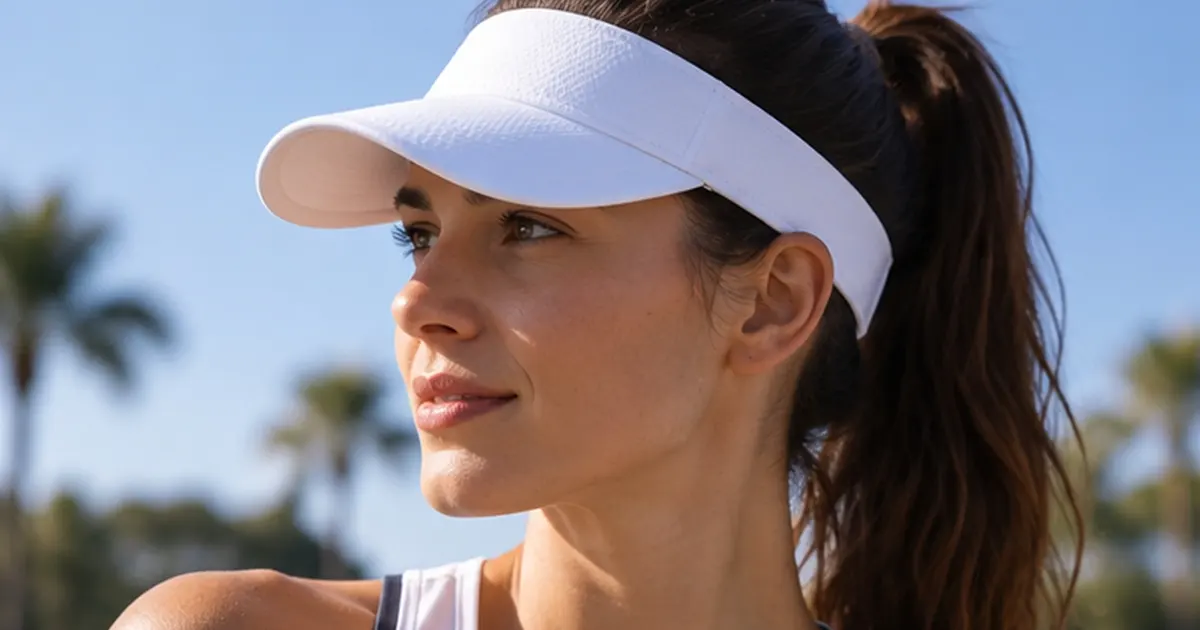
A visor hat is open at the top and consists mainly of a headband with a brim projecting over the eyes. It shades the upper face while leaving the crown of the head uncovered. That makes it popular for golf, tennis, running and other warm-weather activities where airflow, low weight and room for hair are priorities.
“Visor” can also mean the bill of a cap, a helmet face shield or a vehicle sun visor. In headwear, “visor hat,” “sports visor” and “sun visor” usually mean the wearable open-top design described here.
What Makes a Visor Different From a Cap?
A cap has a crown that covers the top and sides of the head. A visor removes that crown and retains the front brim, a band around the head and usually a rear closure. The missing crown is not a small styling detail; it changes airflow, stability, sun coverage, sweat management and decoration space.
| Part | Function | Design questions |
| Brim or bill | Shades the eyes and upper face | How long, wide, curved and stiff is it? |
| Front band | Connects the brim to the headband and supports the front | Is it low and flexible or tall and reinforced? |
| Sweatband | Contacts the forehead and absorbs or moves moisture | Is it soft, quick drying and securely attached? |
| Side and rear band | Wraps around the head to hold the visor in place | Does it distribute pressure evenly? |
| Closure | Adjusts or fixes the circumference | Is it hook-and-loop, buckle, elastic, snap or fitted? |
How the Open-Top Design Affects Comfort
Without crown fabric, heat can escape directly from the top of your head and a ponytail or bun does not need to pass through a small rear opening. The visor also weighs less than many full caps. These advantages are most noticeable during high-output activity or in humid weather.
The tradeoff is equally direct: your scalp remains exposed to sun, rain and cold. People with thinning hair, a visible part or a closely shaved head should not treat a visor as scalp protection. The open top can also reduce stability because there is less fabric gripping the head; band shape and tension therefore matter more.
Brim Shape, Curvature and Visibility
Brim length
A longer brim casts shade farther forward, especially when the sun is high. It also creates more leverage in wind and may enter your peripheral vision when you look upward. A shorter brim feels compact and unobtrusive but produces a smaller shadow.
Brim width
Width determines how far the brim extends toward the temples. A narrow athletic bill keeps the profile streamlined. A broader brim can shade more of the upper face, but it still does not protect the ears or back of the neck.
Curvature
A curved brim wraps some shade toward the sides and often feels natural for running, tennis and golf. A flatter brim creates a different visual line and may sit farther from the forehead at the center. Curvature can be molded into the insert or shaped by the wearer, depending on construction.
Brim angle
The angle where the brim meets the band changes both shade and sightline. A brim that points too low can obstruct your view; one that tilts too high may provide little useful shade. Try the visor in the posture you will actually use—looking down at a golf ball, tracking a tennis serve or running with your head upright.
What Are Visor Hats Made From?
| Material or component | Why it is used | What to check |
| Cotton twill | Classic feel, easy decoration and casual appearance | Drying time, colorfastness and sweat staining |
| Polyester woven fabric | Light weight, durability and compatibility with performance finishes | Actual breathability and hand feel vary by weave |
| Stretch knit | Flexibility and close athletic fit | Recovery after repeated wear and washing |
| Mesh | Reduces weight and increases open area | Placement, snag resistance and whether the sweatband still feels comfortable |
| Foam or laminated front | Adds body for a bold front shape or printed decoration | Heat, moisture retention and delamination risk |
| Brim insert | Maintains shape inside the fabric shell | Flexibility, water response and resistance to permanent creasing |
| Sweatband material | Manages contact, pressure and moisture at the forehead | Width, softness, seam placement and drying behavior |
“Moisture-wicking” should describe tested or documented fabric behavior, not simply the presence of polyester. The complete system matters: face fabric, sweatband, backing, thread, seam density and ventilation all influence how the visor feels after an hour of activity.
How Should a Visor Fit?
A visor should sit level and feel secure without concentrating pressure at the temples. The sweatband should make even contact across the forehead. When you move your head quickly, the brim should not bounce, rotate or slide down toward your eyebrows.
To measure, wrap a flexible tape around the position where the band will sit. Keep it level and snug without pulling tightly. Adjustable visors cover a range, but that range is not unlimited. If you must close the strap at its extreme end, the rear opening may spread too wide or the band may distort.
Pressure distribution matters
A narrow or rigid band can feel tighter than a wider, softer band at the same circumference. Temple pressure often comes from the band shape rather than the nominal size. Elastic designs should stretch enough to stay secure but not remain under severe tension for long periods.
Hair changes the fit
Open-top construction works well with high ponytails and buns, but the hairstyle can still push against the rear band or change its angle. Test the visor with the hairstyle you normally wear. A rough hook-and-loop tab or exposed hardware can snag hair, so inspect the inside and strap end.
Common Visor Closures
Hook-and-loop closure
It is quick to adjust and provides nearly continuous sizing. Over time, the hook surface can collect fibers and the loop surface can lose grip. Covered or rounded strap ends reduce scratching.
Buckle or slide closure
A woven or fabric strap passes through metal or plastic hardware. This gives fine adjustment and a clean appearance, although a loose tail needs a keeper or tuck-in opening.
Elastic back
Elastic removes exposed hardware and can be comfortable during movement. Its useful life depends on stretch recovery, resistance to sweat and laundering, and whether the band begins at an appropriate relaxed circumference.
Fitted visor
A fitted visor has no adjustable closure. It can produce a smooth rear profile but needs more precise sizing. Do not assume a fitted visor size matches your size in a full cap; the band geometry and materials are different.
Snap closure
Plastic snaps provide visible adjustment positions and resist accidental slipping. They are less common on streamlined performance visors but useful when durability and repeatable settings matter.
Why Are Visors Used in Golf, Tennis and Running?
Golf
A visor shades the eyes while leaving the top of the head open, and the lack of a crown can feel comfortable during a long round in heat. Brim angle should not block your view when you look down at the ball. A secure closure is important in wind.
Tennis and pickleball
The brim can reduce overhead glare while the open top accommodates movement and hair. Low weight and a smooth inner band help during repeated directional changes. A brim that is excessively long or loose can distract during serves.
Running
Runners often choose visors for airflow and low bulk. A performance version should resist bouncing, dry quickly and avoid abrasive seams. In exposed sun, however, the uncovered scalp, ears and neck need separate protection.
Casual and event wear
Visors also work as warm-weather uniforms, resort accessories and promotional headwear. These uses may prioritize color, front decoration and adjustable fit over high-output performance.
Does a Visor Protect You From the Sun?
A visor shades part of your face, especially the forehead and eyes, but it does not cover the scalp, ears or back of the neck. The amount of facial shade also changes with brim dimensions, curvature, angle and the sun’s position.
The U.S. Centers for Disease Control and Prevention recommends a hat with a brim all the way around that shades the face, ears and back of the neck for the most protection. A visor does not meet that description. If you choose one for sport or comfort, combine it with broad-spectrum sunscreen on exposed skin, suitable clothing, sunglasses and shade where practical.
Do not infer a UPF rating from color or fiber content. If the brim fabric carries a verified UPF claim, that claim applies to the covered area; it does not compensate for the open crown.
Visor vs Baseball Cap
| Question | Visor | Baseball cap |
| Top coverage | Open | Crown covers the scalp |
| Airflow | Direct airflow at the top | Depends on fabric, eyelets and mesh |
| Hair accommodation | Easy for high ponytails and buns | Limited by crown and rear opening |
| Sun coverage | Primarily upper face | Upper face plus scalp, but ears and neck remain exposed |
| Decoration area | Small front band | Larger crown area |
| Stability | Depends heavily on band tension | Crown provides additional contact and support |
Choose a visor when top airflow and hair freedom matter most. Choose a cap when scalp coverage, crown decoration or a more stable enclosed fit matters. Neither provides the all-around shade of a broad-brim design.
How to Choose the Right Visor
- Define the activity. Golf, running, casual wear and uniforms require different brim and sweatband behavior.
- Check the actual band size. “Adjustable” is not a measurement.
- Look at brim dimensions and angle. Make sure shade does not come at the expense of visibility.
- Inspect the sweatband. It is the main contact surface and often matters more than the outer fabric.
- Test the closure. Confirm that it stays set, does not snag hair and leaves no sharp edge against the skin.
- Consider sun exposure honestly. Plan separate protection for the uncovered scalp, ears and neck.
- Review care instructions. Sweat, sunscreen and heat can affect color, adhesives, elastic and brim shape.
Care and Maintenance
Follow the care label. After heavy use, allow the visor to dry fully rather than leaving it compressed in a gym bag. If hand washing is permitted, use mild detergent and avoid bending the brim sharply. Reshape it during air drying.
Clean hook-and-loop closures by removing lint gently. Rinse salt and sweat residues promptly when the material allows. Do not expose elastic or laminated brims to high heat unless the product instructions specifically permit it.
Frequently Asked Questions
Is a visor considered a hat?
Yes. It is commonly grouped with hats and caps, although it has no crown. “Headwear” is the most precise broad category.
What is the top part of a visor called?
A wearable sports visor does not have a top crown. The part over the eyes is the brim or bill, and the section around the head is the band.
Can a visor protect your scalp?
No. The open crown leaves the scalp exposed. Hair provides variable and incomplete coverage, so additional sun protection may be needed.
Why do golfers wear visors?
A visor shades the eyes while allowing direct airflow over the top of the head. It also accommodates hairstyles that may not fit comfortably inside a cap.
Are visors one size fits all?
Many are adjustable, but every closure has a usable range. Band shape, material and pressure distribution also affect fit, so one label does not guarantee universal comfort.
Is a longer brim always better?
No. It may cast more forward shade, but it can catch wind, bounce or enter your field of view. Choose length together with stiffness, curvature and activity.
Can you wash a visor in a washing machine?
Only if the care label permits it. Machine agitation and heat can deform the brim, weaken adhesives or damage elastic and closures.
Final Takeaway
A visor is an open-top headwear design built around a brim, headband and sweatband. Its main advantage is direct top airflow with minimal bulk; its main limitation is incomplete sun and weather coverage. The right choice balances brim geometry, pressure, closure, moisture handling and the conditions in which you will wear it.
For a custom visor program, HENGXING can help translate those choices into a coherent specification for fit, fabric, sweatband, closure and brim construction.