
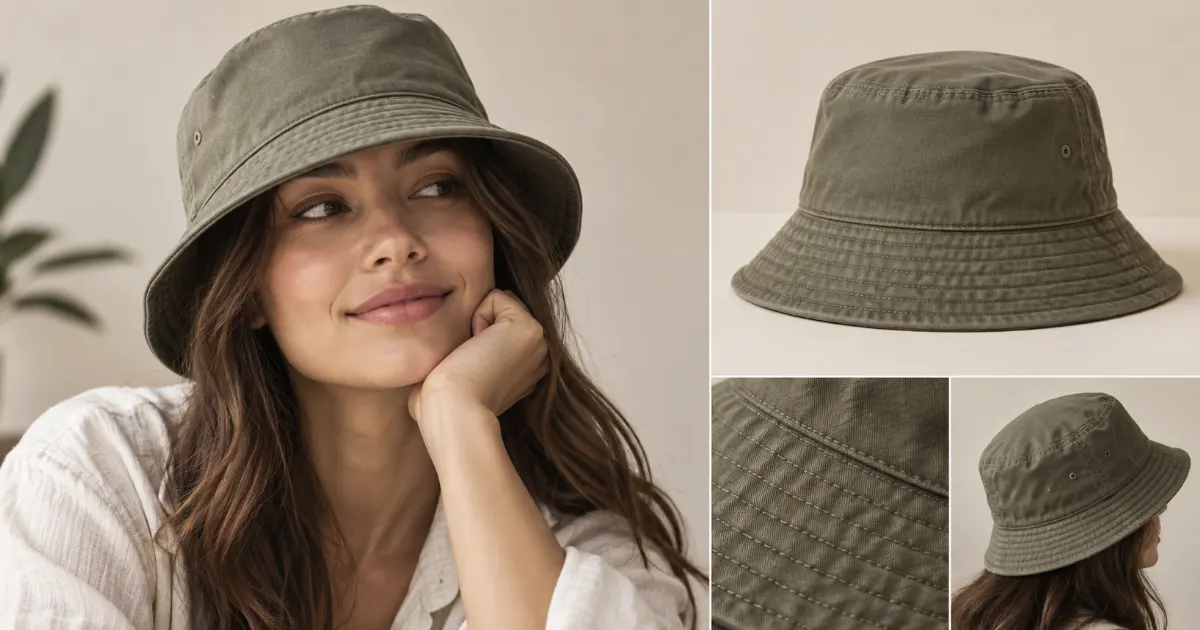
A bucket hat is a soft, close-fitting hat with a crown and a brim that runs all the way around it. The brim usually slopes downward rather than projecting only from the front. That simple construction gives the hat its recognizable shape, makes many versions easy to pack, and provides more all-around shade than a visor or standard baseball cap.
The name describes the silhouette, not a single fabric or performance level. One bucket hat may be a lightweight cotton fashion piece; another may use quick-drying synthetic fabric, a wider brim, ventilation and a chin cord for outdoor use. To choose well, you need to look beyond the label and examine the brim, crown, fit, fabric and intended use.
What Makes a Hat a Bucket Hat?
A conventional bucket hat has three defining parts: a soft crown, a full-circumference brim and a flexible construction. The crown often uses a flat or gently shaped top joined to a side band. The brim is stitched around the lower edge of the crown and normally angles down around the face.
| Design element | What it does | What to check |
| Crown | Holds the hat on the head and controls depth | Depth, taper, panel seams, lining and ventilation |
| All-around brim | Creates the bucket silhouette and provides circumferential shade | Width, downward angle, stiffness and symmetry |
| Sweatband | Sits against the head and influences comfort and grip | Softness, absorbency, stretch and seam bulk |
| Topstitching | Helps stabilize the brim and affects how it folds | Row spacing, puckering and edge consistency |
| Eyelets or mesh | Allows some heat and moisture vapor to escape | Placement, backing, corrosion resistance and actual open area |
| Chin cord, if present | Improves retention in wind or movement | Adjustability, attachment strength and breakaway requirements |
Not every bucket hat is floppy. Additional stitching, interlining or a denser fabric can make the brim more stable. Nor must the crown be perfectly cylindrical. Some crowns taper toward the top, while others are deeper and straighter. These variations change appearance and fit without changing the basic hat type.
How the Brim Changes Coverage and Appearance
The brim is the most important visual and functional feature. A narrow, soft brim sits close to the head and feels casual. A wider brim casts more shade but takes up more space, catches more wind and may need extra structure to avoid drooping into your field of vision.
Brim width
Measure brim width from the crown seam to the outer edge. Do not rely on a product photo alone: camera angle and crown size can make the same brim look wider or narrower. A short brim favors a compact streetwear shape. A medium brim balances packability and everyday coverage. A genuinely wide brim moves the hat closer to sun-hat territory.
Brim angle
A steep downward angle frames the face and creates the classic bucket shape. A flatter angle increases the apparent diameter and may provide a different shade pattern. The angle also changes after washing, folding or steaming, especially when the brim has little internal support.
Brim stiffness
Stiffness comes from fabric weight, multiple fabric layers, interfacing and rows of topstitching. A very soft brim packs easily but may collapse in rain or wind. A firmer brim holds a cleaner line but can feel bulky when folded. Neither is automatically better; the useful choice depends on whether you prioritize portability, shape retention or coverage.
Bucket Hat Materials Explained
Material names tell only part of the story. Fiber content affects feel and moisture behavior, while weave, fabric weight, finishing, lining and construction determine much of the hat’s real-world performance.
| Material | Typical strengths | Tradeoffs and best uses |
| Cotton twill or canvas | Familiar hand feel, durable surface, easy casual styling | Can hold moisture and dry slowly; useful for everyday and workwear-inspired hats |
| Cotton poplin | Lighter and smoother than heavy twill | Less rigid and may wrinkle more; suitable for warm-weather fashion styles |
| Polyester | Can be lightweight, colorfast and quick drying | Comfort varies with weave and finish; common in sport and travel designs |
| Nylon | Often light, abrasion resistant and packable | May feel warm without ventilation; frequently used for outdoor hats |
| Wool or wool blend | Warm hand feel and a more substantial appearance | Usually less suitable for hot, wet conditions; check care requirements |
| Recycled synthetic fabric | Can reduce reliance on virgin fiber and support specific material goals | Performance still depends on yarn, weave, finish and verified sourcing |
Water resistance is a finish or construction claim, not a synonym for nylon or polyester. Likewise, a dark or tightly woven fabric may block more ultraviolet radiation than a loose, open fabric, but you should not assume a hat has a tested UPF rating unless the product documentation states one.
How Should a Bucket Hat Fit?
A bucket hat should sit securely without creating a pressure line. The sweatband should contact the head evenly, and the crown should be deep enough to resist lifting off without covering your ears or forcing the brim into your eyes.
To measure your head, place a flexible tape around the position where the sweatband will sit—typically across the mid-forehead and around the widest part at the back. Keep the tape level and comfortably snug. Compare that measurement with the specific size chart for the hat, because labels such as S/M and L/XL are not standardized across every supplier.
Signs the hat is too small
- It leaves a strong pressure mark or causes a headache.
- The crown rides high instead of settling naturally.
- The brim buckles upward near the temples.
- You need to stretch the sweatband to put it on.
Signs the hat is too large
- It rotates or lifts in a light breeze.
- The crown drops onto your ears or the brim blocks your eyes.
- You need to tilt it sharply just to keep it in place.
Hair volume, lining and sweatband thickness all change perceived fit. If you plan to wear the hat over dense or tied hair, measure and test it that way rather than using a bare-head measurement.
What Are Bucket Hats Used For?
Bucket hats cross several categories because the basic shape is adaptable.
- Everyday wear: Soft cotton twill and balanced proportions make an easy casual hat.
- Travel: Crushable versions fold into a bag, although repeated folding can create permanent brim lines.
- Outdoor activity: Wider brims, quick-drying fabric, ventilation and retention cords can improve usefulness.
- Rain: A treated shell may shed light rain, but seam construction and finish determine whether water eventually passes through.
- Uniforms and events: The uninterrupted crown and brim offer multiple decoration zones, though curved surfaces require careful artwork placement.
- Cold weather: Wool blends, fleece linings or ear-covering proportions can make the shape suitable for cooler conditions.
Is a Bucket Hat Good for Sun Protection?
A bucket hat can provide useful shade because the brim surrounds the head, but the word “bucket” does not guarantee adequate sun protection. Coverage depends on brim width and angle, while UV transmission depends on the fabric, color, weave, condition and any verified protective rating.
The U.S. Centers for Disease Control and Prevention recommends a brim that shades the face, ears and back of the neck, together with other protective measures. The Cancer Council Australia uses a 6 cm adult bucket-hat brim as a sun-protection guide. Treat that measurement as a practical benchmark, not proof that every hat with the same width performs identically.
For prolonged exposure, inspect the actual shadow the hat creates, look for a credible UPF claim when needed, and combine the hat with shade, suitable clothing, sunglasses and sunscreen on exposed skin. A narrow fashion bucket hat may be comfortable and attractive without being the right choice for intense sun.
Bucket Hat vs Boonie Hat, Sun Hat and Baseball Cap
| Hat type | Typical distinction | Best understood as |
| Bucket hat | Soft crown with a downward, all-around brim | A versatile shape used in fashion, travel and outdoor designs |
| Boonie hat | Usually a wider, more horizontal brim with field features such as a chin cord or branch loops | An outdoor or tactical design; some styles overlap visually with bucket hats |
| Sun hat | A broad functional category defined by intended coverage rather than one construction | May include bucket, broad-brim, legionnaire and other shapes |
| Baseball cap | Crown with a bill projecting only from the front | More face-focused shade and a sport-derived silhouette |
The categories can overlap. A wide-brim bucket hat made from tested protective fabric may also be sold as a sun hat. A bucket hat with a cord and outdoor fabric may resemble a boonie, but the product’s construction and feature set matter more than the marketing name.
Common Bucket Hat Variations
Reversible bucket hat
A reversible construction gives you two visible sides, but it complicates labeling, seam finishing, eyelet backing and decoration. Check whether the brim holds its shape equally well in both directions.
Packable bucket hat
Packable usually means the material and brim can tolerate folding. It does not mean the hat will emerge perfectly smooth. Thin synthetic shells tend to recover differently from heavy cotton canvas.
String or chin-cord bucket hat
A cord helps in wind and active use. For children or work environments, cord design may need additional safety consideration; a fixed cord is not suitable for every setting.
Ventilated bucket hat
Metal eyelets, embroidered eyelets and mesh panels all provide different open areas. Two small eyelets may add visual detail without producing the airflow of a real mesh section.
How to Choose the Right Bucket Hat
- Start with the use case. Daily wear, fishing, travel, rain and promotional use place different demands on the same silhouette.
- Check the dimensions. Crown depth and brim width are more informative than “one size” or a styled photo.
- Match material to conditions. Consider drying time, stiffness, abrasion, warmth, noise and care—not fiber content alone.
- Decide how much structure you want. A soft brim packs easily; a supported brim gives a more controlled outline.
- Evaluate ventilation and retention. These become more important in heat, wind and movement.
- Verify performance claims. Look for test-backed UPF or water-resistance information when those features affect safety or purchasing decisions.
- Review care instructions. Washing, heat and aggressive wringing can change crown size and brim shape.
Care and Shape Retention
Follow the sewn-in care label first. If hand washing is permitted, use cool water, mild detergent and minimal twisting. Reshape the crown and brim while damp, then air-dry it on a form that does not stretch the sweatband. High heat can shrink natural fibers, distort interlining or damage coatings.
For storage, avoid crushing a firm brim under heavy objects. A soft travel hat can be rolled or folded for short periods, but long-term compression may set creases. Salt, sweat and sunscreen residue should not be left indefinitely because they can discolor fabric and stiffen the sweatband.
Frequently Asked Questions
Why is it called a bucket hat?
The crown and downward all-around brim create a simple silhouette that resembles an inverted bucket. The name refers to the shape, not the hat’s material.
Are bucket hats unisex?
Yes. The construction is not gender-specific. Size, color, brim proportion and styling determine how an individual design looks and fits.
Can you wear a bucket hat in the rain?
You can, but water performance varies. A dense or treated fabric may shed light rain, while an untreated cotton hat can absorb water quickly. Check the shell, seams and stated finish rather than assuming the hat is waterproof.
Should a bucket hat cover your ears?
The crown should normally sit above the ears while the brim shades around them. If the crown rests heavily on your ears, it may be too deep or too large for your head.
Can a bucket hat be structured?
Yes. Although many are soft, interfacing, multiple layers and dense topstitching can give the crown or brim more structure.
What is the best material for a bucket hat?
There is no single best material. Cotton twill works well for a classic casual feel; nylon and polyester are often better for light, quick-drying designs; wool blends suit cooler weather. The right answer depends on climate, finish, weight and intended care.
Final Takeaway
A bucket hat is defined by its soft crown and all-around brim, but its usefulness comes from the details. Brim geometry controls shade and visibility; crown depth controls stability; fabric and construction control comfort, recovery and weather behavior. Once you compare those features instead of relying on the name alone, you can choose a hat that fits the way you actually plan to wear it.
For custom headwear development, HENGXING can help translate a chosen brim, crown, material and fit direction into a production-ready bucket-hat specification.