
A low profile hat has a shallow crown that sits close to your head. Its front rises less sharply from the visor and slopes back sooner than a mid- or high-profile cap, creating a compact, streamlined silhouette.
Low profile describes crown shape and depth. It does not tell you whether the hat is structured, unstructured, five-panel, six-panel, fitted, or adjustable. Those are separate features, and almost any of them can be combined with a low crown.
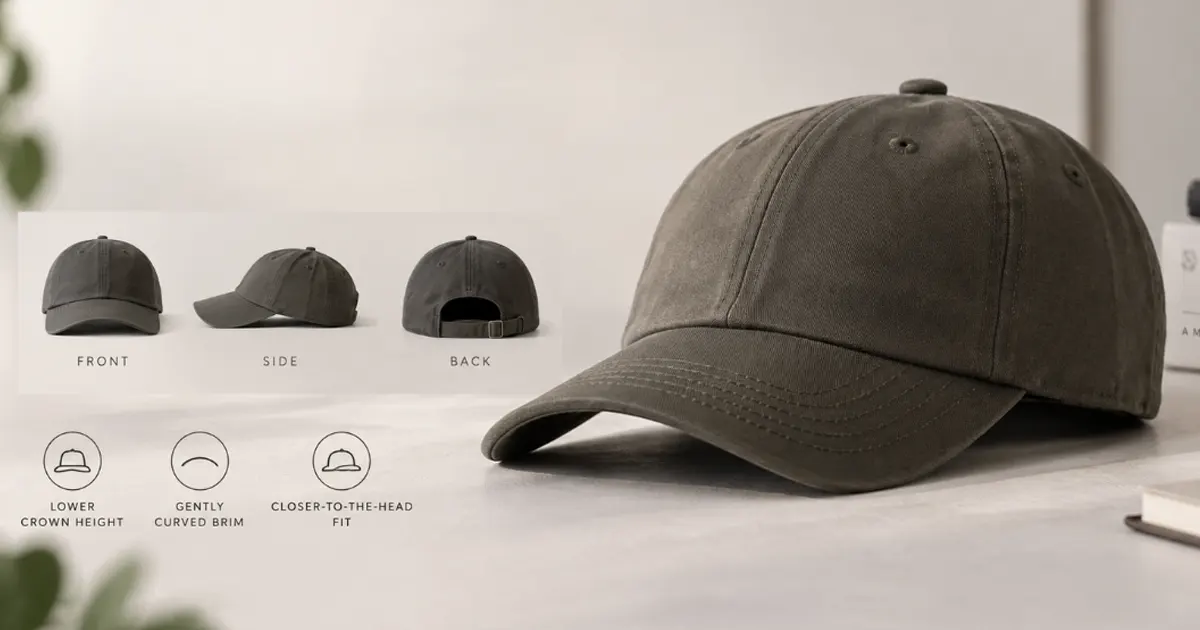
Low Profile Hat Features at a Glance
| Feature | Typical effect | What can vary |
|---|---|---|
| Front crown | Shorter rise above the visor | Height, slope, and angle |
| Crown depth | Sits closer to the top of the head | Side and rear depth |
| Structure | Soft or lightly shaped appearance is common | Firm structured versions also exist |
| Panels | Five or six panels are common | Seam layout and pattern geometry |
| Visor | Often pre-curved | Flat and lightly curved options |
| Closure | Often adjustable | Snapback, strapback, fitted, or stretch-fit |
| Logo area | Less vertical room | Usable space depends on front shape and seams |
What Does Hat Profile Mean?
Profile is the visible height and depth of the crown, especially the front section above the visor. You notice it in the space between your head and the top of the cap, the angle of the front panel, and the way the crown continues toward the back.
A single height number cannot describe the whole fit. Two caps may rise the same distance above the center of the visor, yet one can feel deeper because its side and rear panels extend farther down. Front angle, head opening, sweatband thickness, fabric stretch, and visor position also change the worn shape.
Low, mid, and high are relative categories rather than universal measurements. A “low profile” from one brand may sit like a “mid profile” from another. If a certain fit works for you, compare the actual crown depth and side silhouette instead of relying only on the label.
Low vs Mid vs High Profile Hats
| Profile | How it sits | Visual effect | Common fit concern |
|---|---|---|---|
| Low | Close to the top of the head | Compact and understated | Can feel shallow or ride up on some head shapes |
| Mid | Moderate crown room | Balanced and familiar | May still vary widely by brand and structure |
| High | Leaves more space above the head | Tall, bold, or boxy | Can feel loose or visually oversized if too deep |
None is automatically better. Some people like a crown that nearly touches the top of the head; others want extra room above the forehead or for thicker hair. Profile is a fit preference as well as a visual choice.
Low Profile Is Not the Same as Unstructured
These terms answer different questions. Profile describes height and depth. Structure describes whether the front panels have internal support.
A structured low-profile cap can have firm buckram behind a shallow crown. It stays crisp without standing tall. An unstructured low-profile cap has little or no rigid front support, so it bends around the head and folds more easily when removed.
Many casual hats combine both features, which is why the words are often confused. Still, changing structure changes the feel and logo surface without necessarily changing crown height. The distinction is covered in more detail in the structured vs unstructured hat comparison.
Is a Low Profile Hat the Same as a Dad Hat?
No. A dad hat usually combines a low profile with an unstructured crown, curved visor, and adjustable fabric strap. Low profile is only one part of that package.
A shallow fitted team cap, a firm six-panel baseball cap, a five-panel running cap, or even a snapback can also be low profile. If you want the familiar soft dad-hat look, focus on the full feature combination rather than the crown label alone. The dad hat vs baseball cap guide shows how those features work together.
Who Does a Low Profile Hat Fit Best?
A low-profile hat often feels natural if you dislike empty space above your head or a front panel that stands upright. It can also suit people who prefer an understated cap that does not dominate the face.
That does not make it a “small-head hat.” Circumference measures around the head; profile describes the crown above it. A cap can have a wide circumference and a shallow crown. A smaller head can still need more depth because of a long oval shape, thick hair, or a preference for wearing the cap lower.
Pay attention to four signals when trying one on. The crown should not stop before reaching the top of your head. The back should not pull upward. The sweatband should not press sharply at the temples. The visor should remain at a natural angle instead of tipping up because the front is too shallow.
Panel Count Changes Shape, Not the Definition
A low-profile 5-panel cap may use one broad front and low side panels to create a compact camp silhouette. A 6-panel version uses two front panels with a center seam and often looks rounder. Both can sit equally close to the head.
The number of panels affects seams and shaping, but crown depth comes from the pattern. A tall 5-panel and a shallow 6-panel are both entirely possible. See the 5-panel vs 6-panel comparison for a closer look at seam layout and silhouette.
Visor and Closure Choices
A pre-curved visor is common because it follows the close-fitting line of the crown and frames the face. It is not required. Flat and lightly curved visors can work when their width, length, and angle feel balanced with the shallow front.
Closure is just as flexible. A fabric strap and buckle create a soft, casual back. Plastic snaps make the circumference quick to adjust. Hook-and-loop tabs are simple and light, while fitted and stretch-fit backs remove the opening entirely.
Remember that an adjustable closure solves only part of fit. Opening the back can relieve band pressure, but it cannot create more room at the top or change the width of the crown.
Logo Placement on a Shallow Crown
A low front gives you less vertical space between the visor seam and the top of the crown. Tall logos can look squeezed, touch the visor, or run into an upper seam. Shorter horizontal marks and compact emblems often sit more naturally.
Structure changes the surface. A firm front resists stitch pull and keeps a patch looking flatter. A soft front moves under dense embroidery and may show puckering around large filled areas. Five-panel crowns often avoid a center seam, while six-panel crowns may place that seam beneath a centered logo.
Side artwork also sits closer to the sweatband on a shallow cap. A design that looks well placed on a flat panel can appear low or tilted once the hat curves around your head.
Materials and Weather
Cotton twill gives a low-profile hat a familiar matte surface. Washed cotton makes the crown feel and look more broken in. Canvas adds body, corduroy adds texture, and wool blends bring warmth. Nylon and polyester can support lighter outdoor or performance styles, while mesh sections add more direct airflow.
Material can change fit. A thick, firm fabric occupies more space and may hold the crown away from the head. A light fabric drapes closer, while stretch changes how the cap wraps around the sides. Replacing one fabric with another can make the same pattern feel different.
Do not treat polyester, nylon, or mesh as proof of quick drying, water resistance, or UV protection. Those properties depend on construction, finish, coverage, and testing. The hat materials guide explains what each material label does—and does not—tell you.
How to Choose a Low Profile Hat
Choose by fit first. If the cap touches the top of your head comfortably, stays level, and does not lift at the back, the crown depth is probably close. Then decide whether you want a soft crown that follows your head or a firm front that holds a cleaner line.
Match the visor and logo to the smaller front area. A strong pre-curve can make the cap feel even more compact, while a flat visor adds width. Short embroidery and flexible decoration usually look more balanced than a tall, rigid patch on a very shallow crown.
Why Crown Height Is Hard to Compare by Number Alone
Crown height can be measured in more than one way. A tape may follow the surface from the center of the visor seam to the crown top, or a straight measurement may record vertical rise. Those figures are not interchangeable. The highest point can also shift when the front slopes or the crown is pinched.
Side and rear measurements add the missing context. A cap with a short front can still feel deep if the side panels extend low around the ears. Another may look tall from the front but taper quickly at the back. The visor-to-crown angle changes the silhouette again, especially when the brim is strongly curved.
This is why a universal “low profile equals a certain number of inches” rule is unreliable. Pattern size, measurement method, head circumference, and the intended wearer all change what the number means. A clear side view and an on-head fit check often tell you more than one height figure.
Low Profile Fit Problems and Practical Fixes
| What happens | Likely cause | What to compare next |
|---|---|---|
| The cap keeps riding upward | Crown is too shallow or narrow | More side and rear depth, not only a looser closure |
| The top presses against your head | Not enough crown volume | A slightly deeper low profile or a mid profile |
| The back does not reach low enough | Rear panels are too short | A pattern with more rear depth |
| The visor points upward | Front crown and visor angle do not match your head | A deeper front or different attachment angle |
| The sides touch the ears | Side panels or sweatband sit too low | A shallower side shape, even if front height is similar |
| The cap looks flat but feels loose | Circumference is large while crown remains shallow | A smaller band size with the same profile |
Resist the urge to solve every problem with the back strap. Tightening can improve grip around the sweatband, but it may also pull the opening wider, wrinkle rear panels, or increase temple pressure while leaving crown depth unchanged.
Different Kinds of Low Profile Hats
Low-profile dad hats combine a shallow crown with soft unstructured panels, a curved visor, and usually a fabric strap. The fabric settles around the head, so the silhouette looks relaxed rather than sharply outlined.
Low-profile fitted caps keep a closed back and exact size while reducing crown height. They can still be structured, which gives the cap a crisp sports shape without the extra room of a standard high crown.
Low-profile snapbacks use the familiar plastic closure on a shallower block. The crown may be firm or soft, and the visor may be flat or curved. If you like snap adjustment but not the tall streetwear silhouette, this combination can make sense.
Low-profile 5-panel caps often take the form of camp or running hats. The wide front, short side panels, and low rear create a close fit, while lightweight fabric and a flexible visor can make the cap easier to pack.
Low-profile trucker hats use mesh without the traditional tall foam face. A lower fabric front and curved visor create a quieter silhouette, while the rear mesh retains the trucker hat’s direct airflow.
How a Low Crown Changes Visual Proportion
A low-profile hat shows less fabric above the visor, so the brim and logo appear more prominent relative to the crown. A wide flat visor can make the cap look broad. A stronger curve narrows the visible front and pulls attention toward the face.
Logo scale needs the same adjustment. A design that feels balanced on a high crown may fill a shallow front from visor to top seam. Shorter lettering, wider horizontal marks, and compact emblems often fit the available space more naturally.
Color can shift the perception of size. Dark, low-contrast materials make a crown recede visually, while a pale front, contrast piping, or a bold patch draws attention to its shape. These effects do not change physical fit, but they can make the same profile look more or less pronounced.
Care and Reshaping
Low-profile caps rely on a controlled shallow shape, so drying them crushed can make the crown look uneven. Follow the care label, clean gently, and reshape the front, sides, and visor while damp. Let the cap air-dry in a form that supports its intended profile.
Be cautious with steam and heat. They may help relax some wrinkles, but they can also affect coatings, adhesives, plastic components, foam, color, or the visor board. A structured crown that is too tall cannot reliably be turned into a true low-profile pattern simply by pressing it downward.
If the cap is unstructured, store it without a hard fold through the front logo. If it is structured, avoid stacking weight on the face. The shallow crown may take up less space, but its profile still depends on panel seams and internal support holding their intended relationship.
Frequently Asked Questions
What is the difference between low crown and low profile?
The terms usually describe the same general idea: a shallow crown that sits close to the head. Exact shapes still vary between brands and patterns.
Are low profile hats only for small heads?
No. Crown depth and head circumference are separate measurements, and fit also depends on head shape and hair.
Can a low profile hat be structured?
Yes. A shallow crown can contain buckram or lighter front support while keeping its low silhouette.
Can a snapback be low profile?
Yes. Snapback describes the rear closure, so it can be paired with a low-, mid-, or high-profile crown.
Do low profile hats always have curved brims?
No. Curved visors are common, but flat and lightly curved versions also exist.
How can you tell if a hat is too low profile?
It may ride up, pull at the back, press the top of your head, or tilt the visor upward even when the circumference feels loose enough.
Conclusion
A low-profile hat is defined by its shallow crown, not by one panel count, closure, or level of structure. HENGXING can apply that close-fitting silhouette to custom baseball caps with different materials, visors, and decoration styles.